
By Colonel Rohit Dev At 2 p.m. on 6 October 1973, Egyptian artillery opened along the Suez Canal as Syrian armour surged across the Golan Heights. Israel’s confidence in intelligence, geography, and earlier victories met…
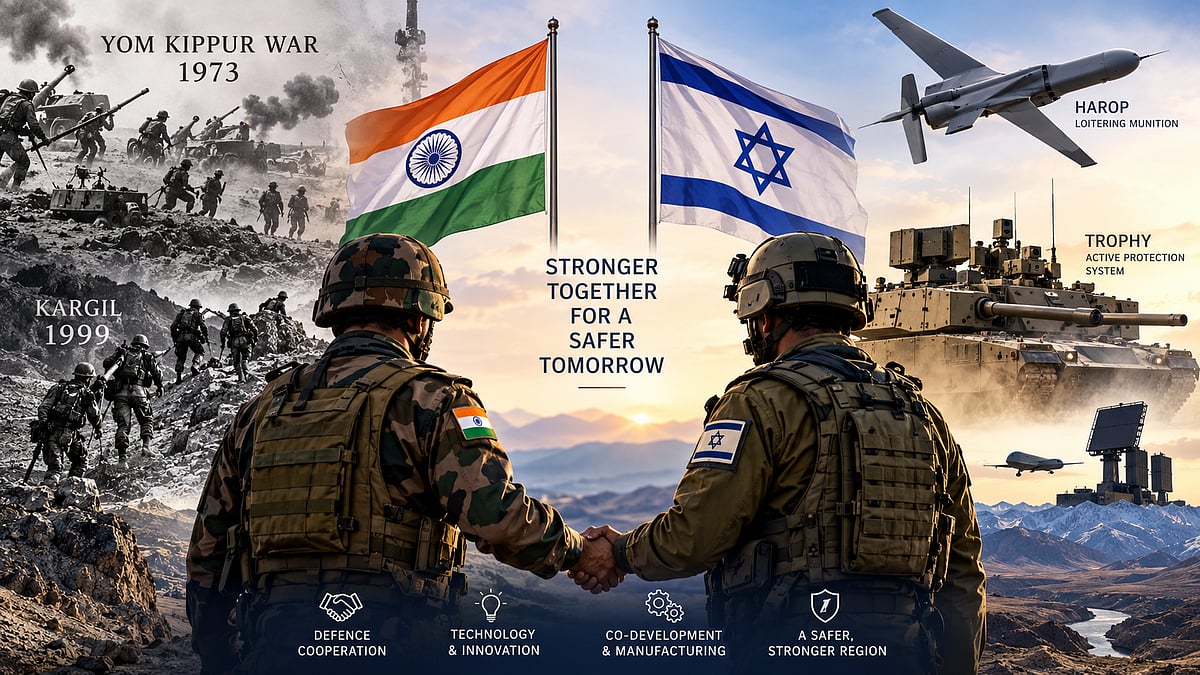
By Colonel Rohit Dev At 2 p.m. on 6 October 1973, Egyptian artillery opened along the Suez Canal as Syrian armour surged across the Golan Heights. Israel’s confidence in intelligence, geography, and earlier victories met a coordinated surprise attack that exposed the limits of assumption. The Yom Kippur War left one enduring lesson for nations facing contested borders and fast-changing threats: deterrence is credible only when a country can absorb surprise, deny an adversary’s objectives, and retaliate with precision. For India, that lesson should inform a deeper and more structured strategic partnership with Israel.The opening assault exposed two critical vulnerabilities. Soviet-supplied Sagger missiles destroyed Israeli armour at standoff range, while a layered surface-to-air missile network severely restricted the Israeli Air Force. Forces built for manoeuvre and air superiority encountered stand-off attack and air denial. The consequences were clearest in the Valley of Tears, where Lieutenant Colonel Avigdor Kahalani and the 77th Armoured Battalion held a much larger Syrian force until reserves mobilised. The valley floor eventually held the wreckage of over 250 Syrian armoured vehicles. The Israel Defence Forces counter-offensive crossed the Suez Canal, encircled Egypt’s Third Army, and recovered ground on the Golan. Israel prevailed, but at the cost of more than 2,600 lives. The lesson Kahalani’s courage established was not that heroism suffices. It was that heroism must be supported by adaptation, or the same price is paid again.Colonel Rohit Dev Israel’s institutional response was an integrated ecosystem: stronger intelligence, electronic warfare, precision strike, unmanned systems, and active protection. Operational failure became engineering urgency. That cycle of problem identification and deployable solution shortened steadily over the decades that followed. The Harop loitering munition and the Trophy active protection system are direct products of this sustained investment. Both were eventually transferred to India, a partner that had drawn comparable lessons from its own conflicts.India’s closest parallel is the Kargil conflict of 1999. Pakistan-backed forces occupied commanding heights, exploiting surveillance gaps and forcing costly uphill assaults. India adapted under fire, massed artillery, improved air-land coordination, and recovered the initiative. The warning from both wars is identical: when deterrence fails before combat, soldiers restore it at far greater cost. That reality also frames the logic of India’s calibrated precision response in Operation Sindoor, which employed Israeli-made Harop loitering munitions and Spice-250 precision glide bomb kits against terrorist infrastructure across the Line of Control. Modern retaliation depends on persistent surveillance, accurate targeting, stand-off reach, and political control over escalation. These capabilities must function as an integrated network, not as isolated imports.Importing advanced systems cannot remain India’s permanent posture. Supply chains can be restricted in a crisis, software becomes obsolete, and equipment designed elsewhere may perform poorly in Ladakh’s altitude or Rajasthan’s heat. Co-development offers sovereign design authority, local sustainment capacity, and exportable intellectual property. The strategic fit between India and Israel is genuine. Both democracies face terrorism, drones, contested borders, cyber pressure, and adversaries who exploit ambiguity below the threshold of open conflict. Both value strategic autonomy and technology as a force multiplier. Israel brings an integrated innovation ecosystem and operational feedback from sustained conflict experience. India brings strategic depth, engineering talent, manufacturing scale, and a large defence market.The institutional architecture is already established. The India-Israel Industrial R&D and Technological Innovation Fund supports joint development and commercialisation. The February 2026 Jerusalem Summit elevated the relationship to a Special Strategic Partnership for Peace, Innovation and Prosperity and gave the Fund its formal mandate as a co-development mechanism. Ambition must now find expression in four operational directions.The militaries should institutionalise complex joint exercises across air, land, maritime, cyber, and space domains, creating shared doctrine and feeding lessons directly to system designers. Co-development should prioritise active protection, autonomous systems, counter-drone networks, and advanced radar, with joint teams adapting solutions for Indian operational environments at altitude, in desert heat, and along the Line of Control. Industrial cooperation must move beyond licensed assembly, defining intellectual property ownership, source-code access, and export permissions from the outset, with Indian firms and laboratories working alongside Israeli partners through a common programme architecture. Both countries should build assured supply chains for ammunition, sensors, drone components, and air-defence interceptors, with joint production capacity serving both armed forces and approved export markets.Yom Kippur’s enduring lesson is not that surprise can always be prevented. It is that surprise must never become paralysis. In 1973, battlefield resilience saved Israel. The deeper achievement came when hard lessons became doctrine, technology, and industrial capacity. India and Israel should make that cycle of adaptation a shared enterprise, exercising together, co-developing critical systems, and securing wartime supply chains. The measure of success will be strategic trust and integrated industries sufficient to ensure that an adversary’s first blow fails to achieve its purpose. On the anniversary of Yom Kippur, the obligation is to affirm that commitment in practice.About the Author: Colonel Rohit Dev, a 2nd Generation Military Veteran, is a Strategic Thinker, with expertise in Geopolitics, Internal Security, Defence, Renewable Energy Sector and a prominent media personalityDisclaimer: The views and opinions expressed in this article are solely those of the author.
Source: Deccan Herald
🔑 Key Takeaways
- Wire dispatch directly ingested from deccanherald.
- Published at Tue, 22 Sep 2026 01:55.
- Source URL: https://www.deccanherald.com/india/the-yom-kippur-lesson-why-india-and-israel-must-build-deterrence-together-4154719