
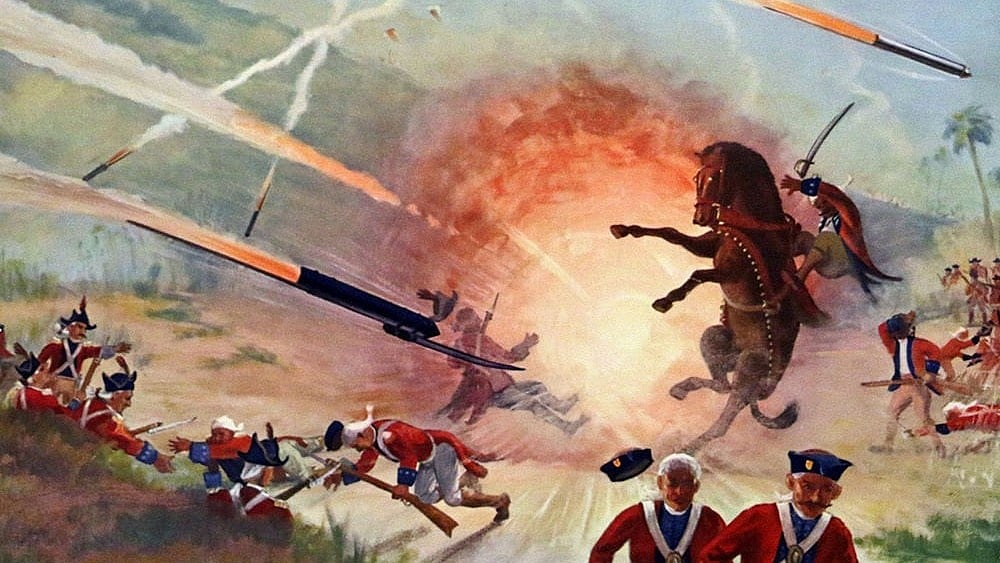
The making of the Mysorean rockets
September is an important month in the country’s military history. Nearly two-and-a-half centuries ago, in this month, the army of the Mysore Kingdom, led by Hyder Ali and his son Tipu Sultan, dealt a decisive blow to the British East India Company at Pollilur near Kanchipuram. The 1780 battle was part of the four-year-long Second Anglo-Mysore War, which ended with the Company being forced to sign the Treaty of Mangalore. According to historians, this was the last time an Indian army dictated terms to its British counterparts.The East India Company’s defeat at Pollilur owed much to a weapon its soldiers had not encountered before: the Mysorean rocket. These rockets, dubbed ‘flying plagues’ by the soldiers who faced their wrath, detonated the Company’s ammunition stores and caused widespread panic in its ranks, making “an extraordinary impression on the British,” wrote noted aerospace scientist Roddam Narasimha in a paper based on a lecture he delivered in Bengaluru in 1985. HistoryThe earliest known use of what we would now refer to as rockets was in 13th century China.Mysuru Dasara 2026: Bookings begin for Gold card, tickets All true rockets, whether used to launch satellites into space or employed as guided missiles, are based on Newton’s Third Law of Motion: an object is pushed forward when a fluid or gas is expelled at high speeds in the opposite direction. However, unlike jet engines, rocket engines do not depend on the ambient atmosphere for its fuel and oxidiser, clarifies H S Mukunda, former Chair of the Aerospace Engineering Department of the Indian Institute of Science (IISc).The Chinese rockets used gunpowder packed in a wooden or paper tube fastened to an arrow or a stick. “History records that potassium nitrate is an excellent oxidiser. Then there is fuel, which is charcoal. Sulphur is added to the mixture to create an energetic reaction. That combination is gunpowder,” Mukunda explains. The rockets soon spread to the Middle East and Europe through the Mongols. But the technology remained largely stagnant for several centuries until it re-emerged in India in a new avatar.Speciality of the rocketThe Mysorean rocket used a similar combustible powder packed in a metal cylinder attached to a bamboo pole or a sword with a leather belt to provide the missile with stability. The rockets came in different sizes. The iron cases ranged from 19 to 30 cm in length, 3 to 7 cm in diameter and weighed anywhere between 500 and 1750 grams.What was remarkable about them was that they could fly up to 2 km, according to eyewitness accounts. The distance they achieved was largely because the combustion chamber was crafted from metal, unlike the pasteboard or wood typically used in European rockets. “Once you have a metal casing, it can carry higher pressure, which means higher thrust,” says Mukunda.A painting showing a rocketman from Tipu’s army about to launch a rocket by lighting its fuse. According to Nidhin George Olikara, who specialises in 18th-century Mysore history, the Mysorean rocket was made with an exceptionally low-carbon, malleable iron, created by introducing large amounts of oxygen into the furnace and using different kinds of wood catalysts. This made the iron easy to roll.It is perhaps not surprising that this rocket innovation emerged in the Deccan, which was known for its metallurgical expertise in medieval times. While some accounts suggest that the Marathas may also have used similar rockets, it is clear that the technology prospered in Mysore, where rockets were manufactured on an industrial scale. Hyder and Tipu created a dedicated force to operate rockets. In his book Tipu Sultan’s Mysore: An Economic Study, economist and historian M H Gopal states that typically 39 rocketmen, or baana-daras as they were called, were assigned to each kushoon or brigade (there were 27 kushoons in Tipu’s infantry, each made up of 1,392 soldiers). These soldiers were trained to launch rockets based on the cylinder’s diameter and the distance to the target.Youth arrested for making reel on Tipu Sultan cutout with pro-Pakistan song in Chikkamagaluru Tipu, whom Narasimha refers to as a “technology buff”, also created manufacturing hubs called Taramandalpets — the name comes from the spectacle of the night sky lighting up when rockets were tested. We know that such hubs existed in at least four places: Bengaluru, Srirangapatna, Chitradurga and Bidanur. Traces of the Bengaluru Taramandalpet can be seen even today, next to the Sangeen Jamia Masjid on Avenue Road, where a 6.5 ft pillar stands as a testament to its days as a rocket development centre.The legacyTipu, however, lost the Third and Fourth Anglo-Mysore wars, for a number of reasons, not least because he was severely weakened militarily by then. But why didn’t the rockets he continued to develop come to his rescue? Rockets, back then, were crude and functioned as force multipliers, relying on surprise, says Nidhin. Once the element of surprise was lost, it wasn’t hard for the British to make tactical adjustments, including hiding their ammunition well away from the rocket launchers.The stone pillar standing next to the Sangeen Jamia Masjid complex in Bengaluru is the only reminder of a Taramandalpet where Mysorean rockets were tested. Photo/authorBut the British, who found hundreds of rockets and shells in the immediate aftermath of Tipu’s defeat, were clearly impressed with the weapon. Several of these were taken back to the Royal Woolwich Arsenal in London, where the British army officer and inventor Sir William Congreve led the development of a new generation of rockets based on the design of the Mysorean rockets. Metal-cased rockets were thus introduced to the West through Mysore, points out Nidhin.The reverse-engineered Congreve rockets, whose military debut was in 1806, were used with some success by the British in the Napoleonic Wars and also in the War of 1812 against the United States. The bombardment of Fort McHenry in Baltimore by Congreve rockets, which inspired Francis Scott Key to write The Star-Spangled Banner, is now a popular story. India, though, lost its tryst with rockets with the defeat of Tipu in 1799. They, however, made a comeback in the 1960s when ISRO was established, and today serve as the backbone of India’s space programme.(The article is part of a series that explores the scientific history of the Bengaluru-Mysuru region, curated by the National Centre for Biological Sciences (NCBS). The author is a science educator and a research fellow at NCBS)
Source: Deccan Herald
🔑 Key Takeaways
- Wire dispatch directly ingested from deccanherald.
- Published at Wed, 23 Sep 2026 18:45.
- Source URL: https://www.deccanherald.com/india/karnataka/mysuru/the-making-of-the-mysorean-rockets-4157191