
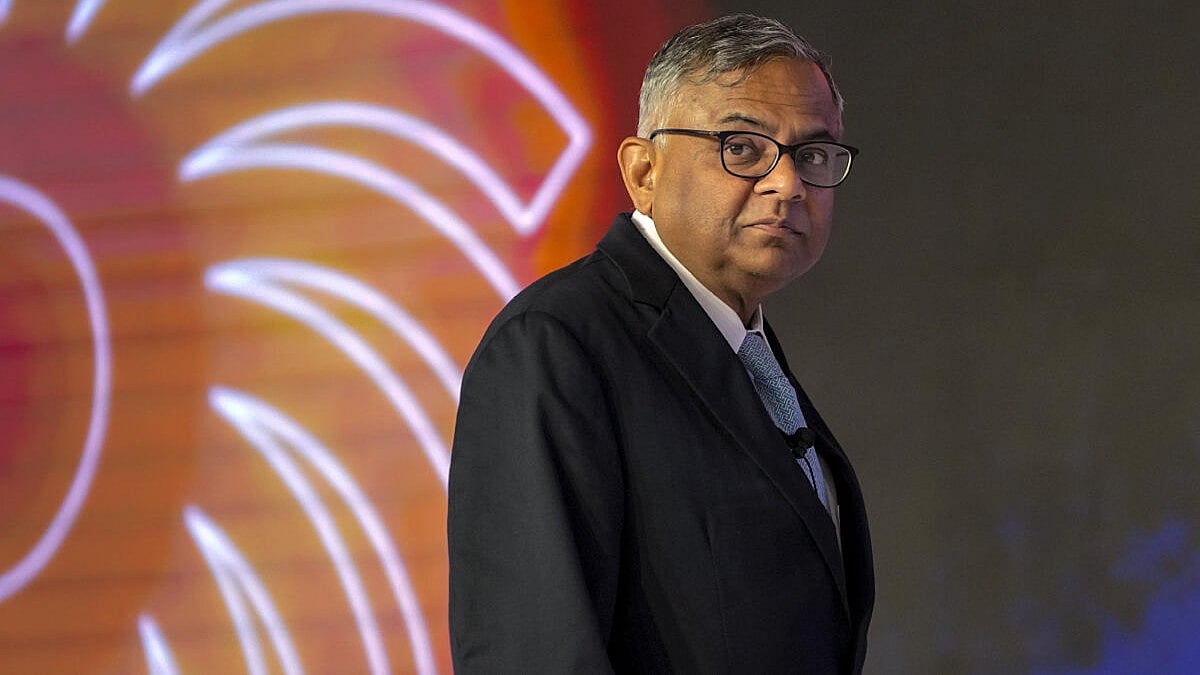
New Delhi: Legal opinions obtained by Tata Sons support the validity of N Chandrasekaran’s reappointment as chairman for a third five-year term, saying the provision in the company’s Articles of Association that requires…
New Delhi: Legal opinions obtained by Tata Sons support the validity of N Chandrasekaran’s reappointment as chairman for a third five-year term, saying the provision in the company’s Articles of Association that requires a Selection Committee applies to the appointment of a new chairman and not to the extension or reappointment of an incumbent.While former Supreme Court judges Justice BN Srikrishna and Justice Uday U Lalit opined that the casting vote exercised by the chairman of the Tata Group board was valid under the company’s Articles of Association, the September 17 board resolution giving Chandrasekaran a third term was on lines of a similar one that gave him a second term in 2022, according to legal opinions reviewed in the matter.Tata Sons Chairman N. Chandrasekaran Receives Honorary Doctor of Science from Sai UniversitySrikrishna said the action was consistent with Article 121, while Lalit said the equality of votes among directors appointed under Article 104B provided an occasion for the chairman to exercise a casting vote.Tata Sons obtained multiple legal opinions after Tata Trusts, which owns about 66 per cent of Tata Sons, challenged the September 17 board resolution giving Chandrasekaran a third term, arguing that its Articles of Association require affirmative support from a majority of Trust-nominated directors and that a chairman’s casting vote cannot override that requirement.”In my opinion, what has been done is perfectly consonant with the letter and spirit of Article 121,” Srikrishna said.Lalit said that of the five board members who voted on the proposal, four voted in favour of appointing Chandrasekaran as chairman. Noel Tata, one of two Tata Trusts nominees on the Tata Sons board, voted against Chandrasekaran’s reappointment, while fellow nominee Venu Srinivasan supported it. With the votes tied among the directors appointed pursuant to Article 104B, the chairman’s casting vote satisfied the requirements of Article 121.Two independent directors voted in favour of the resolution.”Upon there being equality of votes amongst the Directors appointed pursuant to Article 104B, there was certainly an occasion for the Chairman to have a casting vote,” Lalit said.”In my view therefore, the resolution dated September 17, 2026, for approving the agenda was validly passed,” he added.Srikrishna also said the provisions should be interpreted in a way that allows the board’s proceedings and the company’s business to continue rather than become deadlocked.”In my opinion, the proceedings before the Board were not intended to be deadlocked in any event, and that is why it is necessary to read this Article in a manner so as to ensure that the proceedings before the Board and the Querist’s business are taken forward and satisfactorily concluded,” he said.On the duties of directors nominated by entities, Srikrishna said directors have both statutory fiduciary duties to the company and contractual obligations to the entity that nominated them. Where the two conflict, the statutory duty must prevail, he said.”I am of the opinion that every Director has two duties – one his fiduciary duty to the company under the Companies Act and the other to the nominating entity. There is no doubt that the former duty must override the latter in case of a conflict. That is because the former duty is statutory and the latter is only contractual. In the circumstances, Mr Venu Srinivasan rightly acted pursuant to the statutory fiduciary duty.”Senior Advocate Sudipto Sarkar, in a separate opinion, said Article 121 could reasonably be interpreted to permit the chairman’s casting vote in two situations – where votes among directors appointed under Article 104B are tied, or where the votes of the board as a whole are evenly divided.Tata Trusts has maintained that the split vote between its two nominees meant the requirement for affirmative support from the Trusts’ directors was not met. It has also argued that there was no board-level deadlock that could trigger the casting-vote provision and has described the resolution as having no legal effect.Sarkar said Article 118 of Tata Sons’ Articles provides for a Selection Committee to recommend a person for appointment as chairman and refers to the process of “selecting a new Chairman”.The provision therefore does not apply when an incumbent chairman is given another term.Chandrasekaran has been chairman of Tata Sons since 2017. In 2022, he was reappointed for a second term through a board resolution and not through a Selection Committee.The Tata Sons board in February 2022 unanimously approved his reappointment for a further five-year term from February 21, 2022 to February 20, 2027.Chandrasekaran reappointment puts Tata Sons’ governance rules to testHis proposed third term would begin after the expiry of his existing term.He offered a broader interpretation of Article 121, saying the phrase “in the case of an equality of votes” could cover both a tie among directors appointed under Article 104B and an equality of votes across the board as a whole.”On a plain reading of Article 121, it can be said that the Chairman’s casting vote can be invoked in either of the following situations: (i) where there is an equality of votes amongst the directors appointed pursuant to Article 104B; and (ii) where there is an equality of votes of the Board as a whole after taking into account the votes cast by all directors. Accordingly, the expression ‘in the case of an equality of votes’ may reasonably be construed as applying to either situation.”Sarkar also disputed the argument that Article 118, which deals with the selection of a “new Chairman”, governed Chandrasekaran’s reappointment.”Article 118 would not apply to the proposed re-appointment of the Chairman. Article 118 is expressly concerned with the selection of a ‘new Chairman’. The Chairman’s announcement that he will not offer himself for a further term does not alter his status as the incumbent Chairman, and he continues in office until the expiry of his current term in February 2027.”
Source: Deccan Herald
🔑 Key Takeaways
- Wire dispatch directly ingested from deccanherald.
- Published at Thu, 24 Sep 2026 15:52.
- Source URL: https://www.deccanherald.com/business/companies/legal-opinion-backs-n-chandrasekarans-reappointment-as-tata-sons-chairman-4158384