
The tale of the gentle sting operator
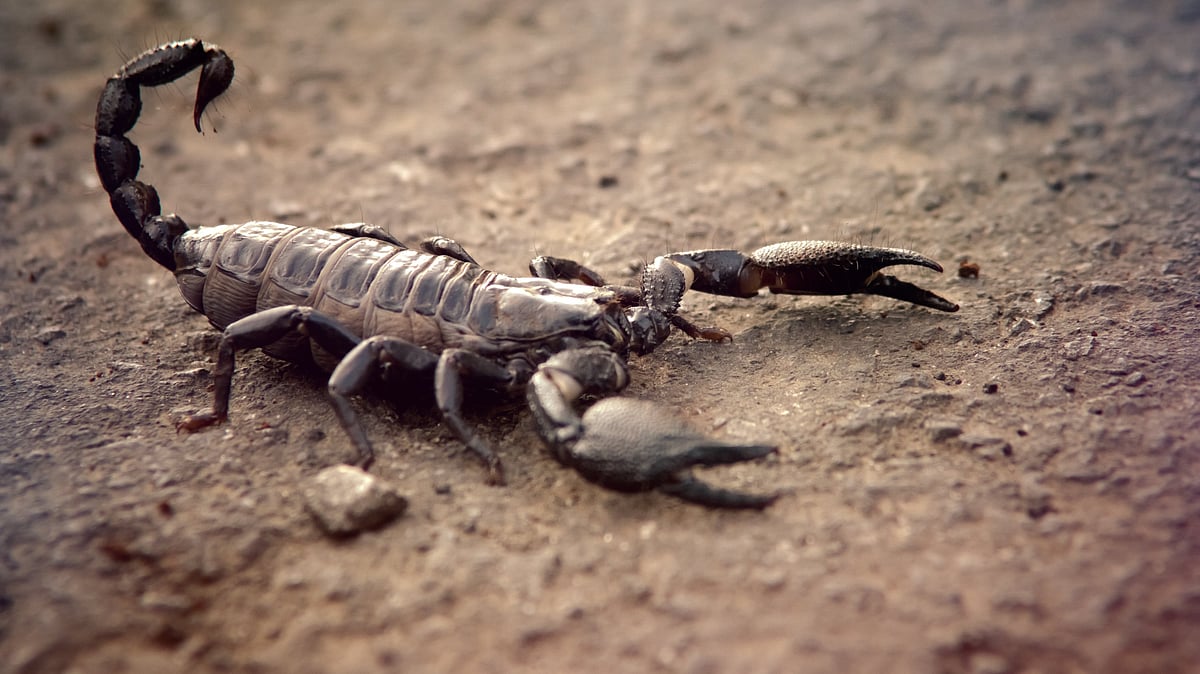
There is a winding jungle path near Navilu Kaadu. We sometimes go on evening walks along this path that leads to a tiny check dam where egrets wade in the shallows, stalking fish. My two boys love these walks, as does Zoey, our shaggy, four-legged girl. We were once delayed returning from the walk. As dusk settled in, we made our way back in the faint glow of our phone torches. Halfway through, Zoey started to furiously sniff at something on the mud path and let out a low growl. When we turned our phone lights towards the thing that incited Zoey’s disgruntlement, a dark form came into view — a scorpion with its menacing stinger raised high up in the air.We picked up Zoey to de-escalate the canine-arachnid faceoff, and hurried home to get out of the way of the creatures of the night. On another day, we encountered the same species just beyond our cottage wall.Both sightings were of a species of Asian Forest Scorpion (Heterometrus sp.), a genus of scorpions known for their large size, at around 5 to 8 inches. The Navilu Kaadu specimen could have possibly been the Mysore Forest Scorpion (Chersonesometrus tristis aka Heterometrus mysorensis), one of the 27 species of Asian Forest Scorpions. Our scorpion was a magnificent, armoured creature, black as a moonless night, with menacing leaf-shaped pincers and an arced stinger. The savage semblance of this scorpion belies its docile temperament, though. As for its venom, if you ever cross paths with this arachnid and manage to rile it up enough to earn yourself a sting, a rash is all you may have to show for the spat. Sadly, this combination of impressive anatomy, a gentle disposition and mild venom makes the Asian Forest Scorpions sitting ducks for the global pet trade.Less than half the rain, a changing forest: What a dry year near Bandipur revealsScorpions predate dinosaurs by almost 200 million years. The oldest scorpion fossil discovered was from the Silurian period (the geologic period spanning 443 million to 416 million years ago) that scientists suspect was among the earliest critters to chart its course from the sea to terra firma. (Wendruff et al., Scientific Reports, 2020)The anatomy of present-day scorpions is still comparable to their prehistoric ancestors that crawled all over Gondwana, the ancient supercontinent. A fused head and thorax, called the cephalothorax, holds the scorpions’ eyes, mouthparts called chelicerae, and a pair of pincers or pedipalps that help grip prey, stave off predators, and feel their way around. Scorpions rely less on sight and more on vibrations and touch. The head and thorax are shielded by a carapace. Four pairs of legs are attached to the cephalothorax. A segmented abdomen tapers into a segmented tail that ends in a telson and holds a pair of venom glands on the inside and a curved stinger on the exterior to envenom prey. Scorpions love tucking into crunchy insects, lizards, and juicy molluscs among other invertebrate and vertebrate delicacies.These miniature battle tanks have a hard exoskeleton that surpasses Ironman’s fancy armour on many counts. Made of a tough material called chitin, the exoskeleton offers protection and acts like a scaffolding for the soft tissue. It stems water loss, helping scorpions adapt to arid habitats. Scorpion exoskeletons demonstrate fluorescence. They contain natural compounds called beta-carboline alkaloids that absorb UV light and re-emit it as visible green or blue-green fluorescence. Scientists hypothesise that fluorescence could be a way to put off predators, attract prey or support metabolism. (Gaffin D.D. et al., 2012). As scorpions grow, they go through ecdysis or moulting, a process where they shed their old exoskeleton for a bigger one.Scorpions are quite the courters. Mating pairs clutch each other’s pedipalps and dance in circles. They even kiss each other’s mouthparts. Most species of scorpions are viviparous — the females deliver their young live and do not lay eggs. Baby scorpions or nymphs hitch a ride on their mum’s back till their first moult.On that note, we once found a scorpion nymph of uncertain identity snuggled up in my older son’s freshly laundered and dried underclothes. It must have snuck in when we put out the clothes to dry. Fortuitously, we discovered the scorpion in time and averted a potential sting operation!(Rooting For Nature is a monthly column on an off-kilter urban family’s trysts with nature on a natural farm. The author runs Green Goobé, a sustainable venture. Reach her at bluejaydiaries@gmail.com or @ramyacoushik on Instagram.)
Source: Deccan Herald
🔑 Key Takeaways
- Wire dispatch directly ingested from deccanherald.
- Published at Sun, 27 Sep 2026 00:16.
- Source URL: https://www.deccanherald.com/features/art-and-culture/5-inch-giants-of-the-forest-the-secret-world-of-indias-asian-forest-scorpions-4159708