
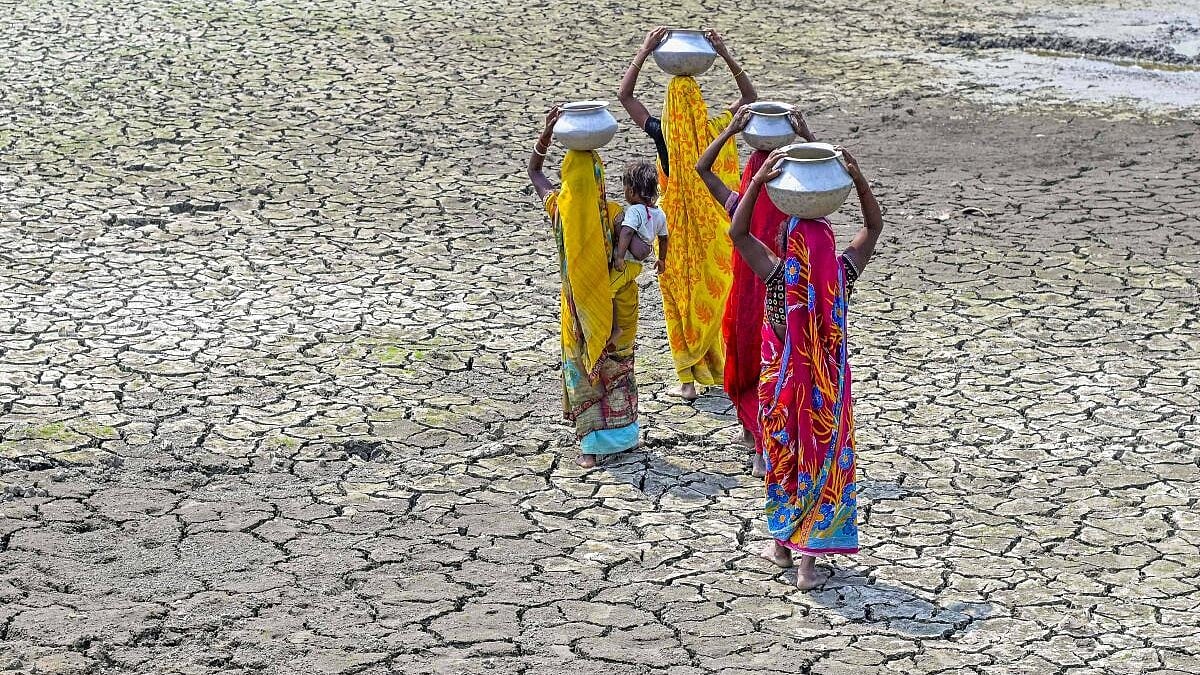
P Sainath’s Everybody Loves a Good Drought showed how a crisis releases money, machinery, and attention that ordinary years never see, and how little of it reaches the people it is meant for. The farmers’ suffering reced…
P Sainath’s Everybody Loves a Good Drought showed how a crisis releases money, machinery, and attention that ordinary years never see, and how little of it reaches the people it is meant for. The farmers’ suffering recedes from public memory and those who briefly cared move on. We borrow it here for a related observation: India’s food and farming policy tends to come alive in a crisis, and go quiet once it passes.Every few years, a monsoon fails, a conflict disrupts a shipping route, or a commodity market swings sharply, making our plates and farmers vulnerable to forces far beyond the farm gate. In response, committees meet, imports are cleared, and subsidies are adjusted. Then the urgency eases.Consider India’s fertiliser situation.When the Strait of Hormuz shut in February, urea climbed past $850 a tonne by April, its highest in four years, threatening to double the subsidy bill. By late June, the price had halved to $445-449 a tonne only to start climbing again by July. In response, the Cabinet approved a new investment policy for urea after 14 years, incentivising additional gas-based urea production capacity.Consider the impact of extreme heat on India’s crops.In 2022, India’s hottest March on record hit wheat, forcing the ministry to slash its harvest estimate by six million tonnes. As wheat prices surged during the Russia-Ukraine conflict, exports were restricted in May, just days after India offered to help fill the global gap. Onions followed with repeated export curbs in 2023-2024. Extreme heat scorched harvests made crop losses a foreign policy issue within weeks.These are different problems, and they require different instruments. But they expose a common weakness: India is better equipped to manage immediate shortages than to systematically reduce exposure to the risks that produce them.Banning an export and pursuing an import are both legitimate ways to adjust for availability. So is subsidising a new urea plant. Whether India is short or long, buying or selling, the lever it reaches for usually moves supply. The framework is familiar: surplus opens the export tap; shortfall opens the import tender. Each intervention answers to the food security of millions.Nevertheless, India has an extensive policy menu to manage the demand side of farming and agri-inputs. For example: The Crop Diversification Programme, the National Mission on Natural Farming, soil health cards, neem-coated urea, the millet mission — they all change how much fertiliser India needs. Because different ministries manage these efforts in silos, they remain disconnected from India’s broader crisis-response frameworks.There is a straightforward reason. Supply can respond in weeks; demand and resilience-building take years. Simply, reactive governance and a supply-side reflex are two sides of the same problem. Then, if crisis should no longer be the principle of farm policy, what should replace it?NITI Aayog’s recent Scenarios Towards Viksit Bharat and Net Zero: Agriculture offers one possible answer: shift the farm policy framework from crisis response to long-term preparedness through planning. For policymakers, this means long-term risk-calibrated roadmaps for food systems. A long-term plan, however, cannot assume clear sailing. Some risks arrive abruptly, such as supply disruption from wars, and others accumulate almost invisibly, like soil degradation. Building these risk-calibrated roadmaps requires three things. Risk intelligence for India’s food systemIndia can track individual risks; what it cannot yet see is how they compound. Soil degradation and climate stress may weaken a region’s productive base; drought or a supply-chain disruption can then trigger crop losses or fertiliser supply disruptions, with consequences for farm incomes, food prices, and national food security.India needs national-to-district food-system risk intelligence that connects slow-onset climate vulnerabilities with immediate exposures, showing not just where risks lie, but where they converge and with what intensities.Stress-test policies against risk intelligenceAgricultural strategies are usually tested against the baseline. They should also be tested against what happens when the baseline breaks: a drought, a heatwave, a trade disruption or a conflict. NITI Aayog’s emphasis on identifying long-term strategic pathways using Integrated food-system modelling creates an opportunity to do this. The question now should no longer be just about what a policy delivers, but what it protects us from, and what new vulnerabilities it may create.Make roadmaps with spatial risk-calibrationA national target can tell the State what to scale, but not how much, when, and where it will deliver the greatest resilience. That requires combining risk exposure with suitability. Scaling natural farming, for instance, should consider not only its implications for food security, but also farmers’ capacity to transition. Spatio-temporal roadmaps can show where an intervention can reduce risk most because no intervention carries the same risk-reduction value everywhere.Preparedness is, thus, needs to be more than the opposite of crisis management. It is what makes crisis management less costly. So, good planning is not about knowing the future. It is about being less exposed to its uncertainties. Because no one loves a good drought.Nikhitha Jagadeesh is Programme Associate and Chandan Jha is Senior Programme Lead, Council on Energy, Environment and Water (CEEW). (Disclaimer: The views expressed above are the author’s own. They do not necessarily reflect the views of DH.)
Source: Deccan Herald
🔑 Key Takeaways
- Wire dispatch directly ingested from deccanherald.
- Published at Wed, 07 Oct 2026 05:35.
- Source URL: https://www.deccanherald.com/opinion/no-one-loves-a-good-drought-yet-policy-waits-for-one-4173274