
The cause of the deadly landslide and flood along the Nepal-Tibet border is still being investigated, but experts say the region’s extreme terrain makes it particularly vulnerable to such disasters, with climate change a…
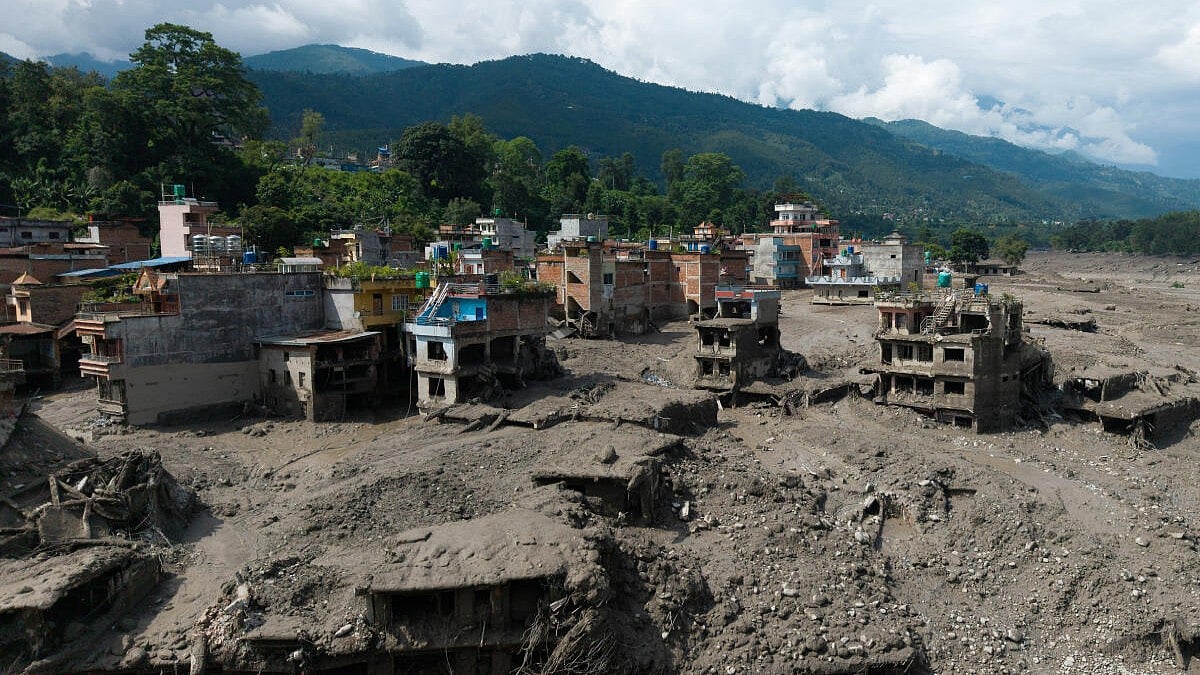
The cause of the deadly landslide and flood along the Nepal-Tibet border is still being investigated, but experts say the region’s extreme terrain makes it particularly vulnerable to such disasters, with climate change adding to the risks.Flash floods and landslides have killed at least 165 people, swept away entire villages and left hundreds missing. Videos from the region showed a terrifying wall of mud and water engulfing buildings and carrying away vehicles.Rescuers in Nepal used helicopters on Thursday to search for hundreds still missing after mud and rock crashed into a river near the Himalayan border with China’s Tibet, sending catastrophic floods through towns and valleys.More than 400 foreigners were among 579 tourists reported missing, Nepal tourism officials said, after the disaster swept a region popular with trekkers and pilgrims, including those travelling to Kailash Mansarovar. Police have warned that the death toll could rise as rescue teams recover more bodies.A drone view shows mud covering buildings and property following devastating floods at Trishuli in Nuwakot district, Nepal.What triggered the floods?Nepal’s Foreign Minister Shishir Khanal initially said an earthquake may have triggered a landslide that blocked a river, eventually causing water to surge downstream after the obstruction gave way.But an updated assessment by the US Geological Survey said the event initially reported as a magnitude 4.4 earthquake was instead “seismic energy generated by a glacial collapse and debris flow”.A preliminary assessment by the International Centre for Integrated Mountain Development (ICIMOD) found no anomalies on the Chinese side of the border.”We believe a rock-ice avalanche occurred in Nepal, blocking the Lhende river and causing the cascading flood event,” Sarthak Shrestha, a remote sensing and geoinformation analyst at ICIMOD, told AFP.An initial study of satellite imagery by Planet Labs also showed that a landslide of ice and rock unleashed a flood carrying debris into the Lhende River, about 20 km (12 miles) northeast of the Nepal-China Rasuwagadhi border crossing.Nepal floods: Karnataka seeks details of stranded citizens, issues helplineWhy was there so little warning?Hydrologist Hatim Sharif of the University of Texas San Antonio said one of the most striking aspects of the disaster was the lack of rainfall beforehand, something that would make conventional flood warning systems far less effective.”That defeats essentially every operational flood warning system in the world,” he told AFP.By the time people see a fast-moving wall of mud and water, it can already be too late to escape. Sharif said running or trying to flee by vehicle would not necessarily help because the fast-moving mud and water can become a lethal combination, which he likened to “liquid concrete”.One possible long-term measure, he said, would be river-level gauges that transmit changes to authorities in real time, potentially giving residents 20 to 30 minutes of warning.Survivors sit on debris as they wait for roads to clear to their homes following devastating floods in Trishuli, Nuwakot district, Nepal.Is climate change involved?Experts say the wider risks facing the Himalayas are being intensified by a warming climate, although it is too early to establish whether climate change directly caused this particular disaster.Dorothy Heinrich, a researcher at the UK’s University of Reading, said hazards such as glacial lake outburst floods (GLOFs) were among the risks associated with a warming planet.GLOFs occur when large volumes of water stored in glacier-fed lakes are suddenly released, potentially causing catastrophic flooding downstream.”We do know what climate change trends look like in the Himalayas,” Heinrich told AFP, pointing to increasing heat, glacial retreat and permafrost loss as factors that can contribute to landslides and glacial outburst floods.Scientists use attribution studies to determine whether an individual extreme event has been made more likely or severe by climate change, by comparing today’s fossil-fuel-warmed climate with conditions in the pre-industrial era.A similar glacial outburst flood occurred in July 2025, originating in China’s Gyirong County before surging into Nepal’s Rasuwa District.India sends military aircraft with relief material to Nepal after flash floodsRescuers search through devastationIn the hardest-hit districts, helicopters have been dropping tents, food and emergency supplies provided by neighbouring India, Nepal’s army said, as rescue teams continue to search for people missing in the disaster.Witnesses described entire settlements being swept away.”It was a huge gush of mud coming straight towards us,” said Keshav Prasad Baral, a 68-year-old survivor being treated in hospital.”As it got closer, it kept rising higher and higher. When I saw it enter our home, I tried to grab my wife’s hand and take her to the terrace. But she was swept away by the mud.”A helicopter took Baral to safety four hours later.”My wife is still somewhere beneath the mud,” he said. “She’s gone.”Another survivor said he saved himself by clinging to a mango tree as he watched the house where he had been working disappear.Security footage from the Chinese side of the border showed people fleeing as a torrent of rock, mud and water swept through the area, destroying buildings and vehicles.Damaged houses following devastating floods, in Trishuli in Nuwakot district, Nepal.In Nepal, families searching for missing relatives gathered outside a Nepali army training centre being used as a base for helicopter rescue operations, while police took down the names of those missing.Television images showed collapsed homes, floating cars and a metal bridge being washed away, while layers of mud covered homes, trees and vehicles as helicopters ferried survivors from the affected areas.”There is devastation everywhere we look,” said Tula Bahadur BK, a health worker in Rasuwa.”The settlements next to the river have been completely swept away. Five of my own relatives are missing.”Risk of another floodThe danger may not be over, with Qianggong Zhang, head of climate and environmental risks at ICIMOD, warning of the possibility of another flood because of an ongoing blockage upstream.China’s official Xinhua news agency said the mudslide had hit the Gyirong port, cutting roads, communication links and power supplies in the border region of Shigatse.A drone inspection showed that roads leading to the border crossing had been “completely destroyed”, a rescuer told CCTV, while attempts to make contact with the Gyirong border port had so far produced no results.
Source: Deccan Herald
🔑 Key Takeaways
- Wire dispatch directly ingested from deccanherald.
- Published at Thu, 27 Aug 2026 03:27.
- Source URL: https://www.deccanherald.com/world/asia/how-did-nepals-deadly-floods-strike-without-warning-experts-weigh-in-as-toll-rises-4125586