
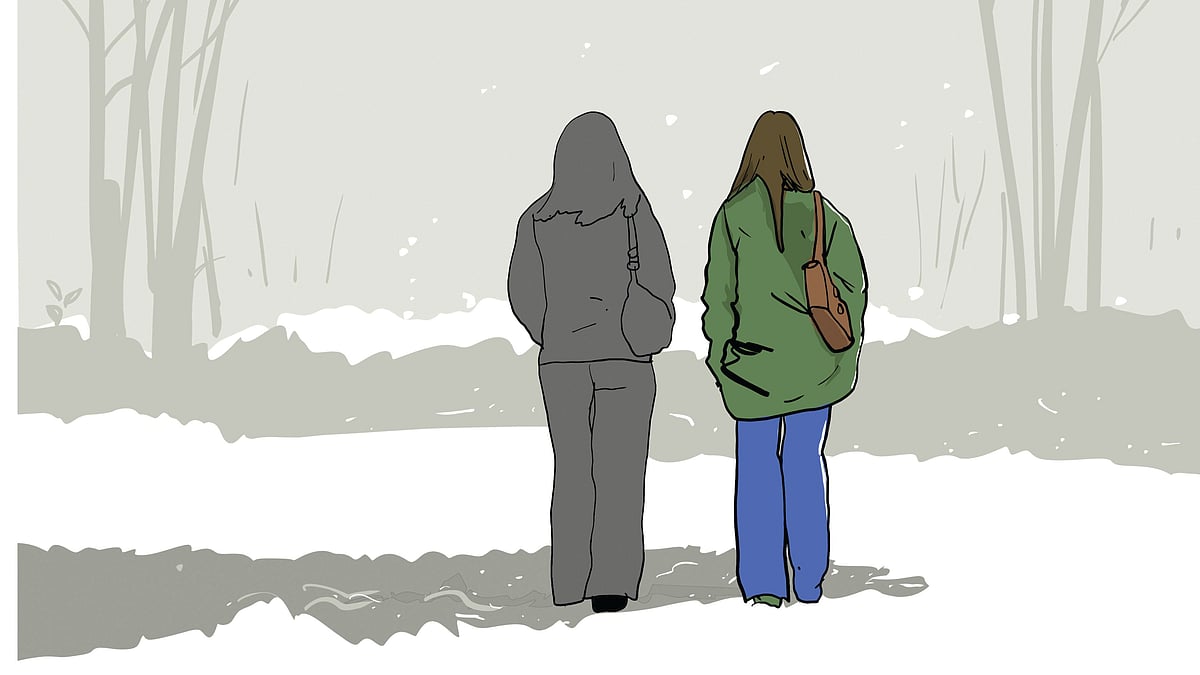
How my friend faked her death for money
On January 9, 2024, my friend, Sanchayita Ruth Lenin, died. She was in her late 20s and had been battling cancer. She had set up a fundraiser page online to meet the skyrocketing cost of her treatments.Now what if I told you that all of the above were lies? Apart from the fundraiser page, of course.It dawned on me and a group of my friends a little too late that Sanchayita, whom we fondly called ‘Sanch’, was scamming us right from the start. She did not have cancer, and she most certainly did not die. She is still very much alive.We live through multiple emotional scams every day.I was 37 when I met Sanch on Instagram. Sanch quickly moved from a social media friend to taking up a much larger space in my head, an unlikely, poignantly intelligent, fierce advocate of a person who could still land a good joke. She was the type of person primed for someone like me to project onto. She was younger, seemingly smarter, politically vocal, and unafraid to be brash online with her takes. She cut the b***s*** with her words.I was the opposite, chronically twisted and shrunk from trying to listen to my own inner voice through my 20s, committed instead to self-abandonment and people-pleasing. My life had started out as an identity crisis, and by 29 (years before I ever met Sanch), I had already lived through realities that people decades older than me hadn’t yet dealt with: divorce, the loss of a parent, and living in between two countries.Sanch was supposed to be only 26. She wore all her battle scars on her sleeve. Her life had been worse than mine by any measure. She was already an orphan; her mother died when she was 16, and her father died of cancer in the pandemic. She was Dalit, she was from Assam, and she had been abused multiple times. But there she was. Still helping people chronically online and standing up for the rights of others without missing an intersectional beat.Of course there was something profoundly missing. I knew it even then, but I could not admit it to myself. There was an utter lack of any real intimacy as friends. My experiences came with emotional wisdom. I was trying to save the goodness in others (and therefore attempting to save the goodness in me). What I saw in her was my own convictions that had been languishing under the pressure of social accommodation.That was what led me to fall for a 20-something who not only liked to tell me about every detail of her life and identity, but went on to fake cancer and her own death.Shocking. But not unheard of. I remember taking to social media in early 2024 to share my ordeal. She had misrepresented herself, her age, her identity, where she was from, and what she did. I have the evidence for it.In the first few months of 2023, I started realising it was all a lie, but I did not have proof. She told us about her diagnosis when she was in Silchar “on a break from college”. But what she would tell us following this news was vague and erratic. She first said she would be going to Delhi for treatment. When I suggested she get treated in Bengaluru, she got upset and said she would prefer to stay in Silchar (her “hometown”) because that is where she wanted to die.She sent us lab reports of all her tests. One day, I scanned the QR code on her lab report. It took us to a different report, with her real name. It was for a dengue test. It was clear that the report she sent us was forged. A friend then called Gauhati Medical College and Hospital and found there was no patient record in her name. That was when we finally confronted her, and it led to her faking her death.Scams of this nature happen all the time; the emotional debris they leave people in, however, is something too painful for people to process, or even recover from, in any real and final way. At the same time, as humans boxed into such oppressive systems, we are living through multiple forms of emotional scams, and will continue to till we die, without any exposé, without any scandal. Some scams are built into the limitations of the world we live in.The timelineThe crux of my book ‘Liar Liar’, which was published earlier this year, happened to me between 2020 and 2024. Apart from being a writer, I have also been involved in a mix of community organising, fundraising, and creative communications and branding. Living between these realities has given me precious context and space to think about us as humans.The trauma response I carried through most of my life was trying to make up for the lack of accountability and earnestness I felt so abandoned by as a child and as a young adult. It meant I would drive myself insane trying to make space for people who had no real reciprocity to offer, who simply took from me. Ironically, I’d also eventually get sick of it and throw entire, carefully constructed relationships out the window, starting from scratch.Writing this memoir was, in fact, the process of me understanding myself. Sure, plenty of people will read it as an account of why she was wrong. But that’s beside the point. The wrongness in what she did exists in many places. To start with, in your own homes, at your jobs, in your friend circles. She’s simply the more prominent, more legible example, the one our brains are wired to pick up with more accuracy and go, ‘bad, that’s bad’.Learning about myselfI examined my experience with brutal honesty about myself, because that’s where anything worth telling starts. Not what happened, but why it happened, and how it can still grow our larger imagination instead of shrinking it. I had to recount what happened to me without looking away from the cringe-worthy truths that led me to be so taken by a person 11 years younger than me, someone who knew every word of social justice language, who carried stories of grief I couldn’t imagine living through.Mandya beggar dies leaving behind over Rs 8 lakh in form of notes and coinsAnd yet it was Sanch — the deceiver, the scammer, the easy villain of this era of my life — who taught me that I had endured so much on my own, and had projected that love and admiration onto her. Why? Because I simply wasn’t ready to cherish my own journey for what it was. I was comfortable handing out aid, emotion, and wisdom to others without extending the same respect to the part of me that had made me that way in the first place.Love and liesSanch didn’t just scam me. She scammed a circle of us, and for Ankur, it was worse. She love-scammed him, on top of every other lie she was running, and he came into it with far less power and agency to fight back than I had. When it all fell apart, he went quiet for the better part of a year. So when I first told him I wanted to write about the ordeal, his response was an absolute ‘no’. I understood that because it was a questions of trust — the exact thing Sanch had turned into a weapon.Here I was, someone who’d been failed alongside him, now asking him to hand his story over a second time, to trust another person to carry something that raw without dropping it, or bending it to serve her own version of events.Our friendship, at that point, was on the ventilator. What brought it back wasn’t a pitch or a persuasive argument. It was deep, vulnerable conversations, the kind where you stop performing for each other and just say out loud how frightened and humiliated you both still were. Slowly, that honesty turned him around, and it turned me right back towards trusting him too. By the time we sat down to actually write his chapters, what we’d rebuilt between us was the same endurance of trust I keep circling back to in this piece. It was proof, in real time, that friendship can survive even after it’s been gutted.Piecing it togetherResearching and writing about this experience was distressing in a very specific way. Very different from fiction. With fiction, I had to build my own brain from scratch: research what made my characters tick, what motivated them, what pushed them towards their beginnings and endings.With this episode, I had to do the opposite. I had to investigate humanity through the circle of people who’d been involved with Sanch; from the people she claimed to love and honour, to the wider Internet that followed and interacted with her online. It meant navigating people’s consent to be written about, and blurring some details so certain people could keep their privacy while I stayed honest to the story. It meant going back through old WhatsApp threads, piecing together timelines, sitting through old voice notes that triggered every kind of insecurity and past version of myself.It also meant going outward, to psychologists and researchers who work with people who could clinically be described as sociopathic, or as living with antisocial personality disorder and what they’ve observed about how such people move through intimacy and relationships. It required understanding why a story with a villain this explicit is so much easier for a reader to sit with and consume. But the quieter, smaller things in the book keep circling something I’ve come to think of as societal sociopathy: the fact that we’re all built to live inside traps designed so that only a few of us can actually thrive, and the cost of that design is paid in our own liberation.It meant bringing it all together while making sure I wasn’t using any of it to punish a person for the sake of it, but to reveal the putrid depths of apathy, entitlement, and pure evil a single person can drown, not just your own belief in anything real, but an entire community’s belief in anything wholesome, honest, and radically beautiful.My writing became less about punishing the idea that people like her could devastate our lives, our hope, our ability to love and rebuild. It became about loving harder, but there is a clarifier. It means understanding how to love the people who witness you as you actually are, and who keep showing up to feed you with what they have to offer.Cancelling versus confrontingThis is why I think it’s urgent and important, especially in the digital age, to tell the difference between cancelling a person and confronting one. Cancelling depends on social power, on bland public optics rooted in binary ideas of good and bad. Even when something is objectively bad, it gives people no way to respond except with anger, by lashing out, and by cancelling harder.Confrontation holds its ground. It states plainly the ironies and hypocrisies we all carry, while still asking for accountability. Confrontation is the audacity to hold a moment, look it in the eye, and say: this is wrong, and I’m going to stay here until you either account for it, make it better, or remove yourself from my life. Cancellation distrusts you; it asks you to react from the most superficial spine of your ego. Confrontation asks for your better self. It asks you to participate in community, to hold a clear boundary, to become a better member of society.This is what I think the larger part of my writing, and my community work, is really about. It’s pushing for confrontation within communities instead of the binary cancellations that lead to nothing more than juicing the public’s chronic anger and deep sadness for a temporary, hollow idea of correction. Confrontation holds us all responsible for the larger evil, and then asks us to be specific about how we respond to one thing, without losing sight of the larger truth.The writer’s book on the topic, titled ‘Liar Liar’ and published by Harper Collins, is out.
Source: Deccan Herald
🔑 Key Takeaways
- Wire dispatch directly ingested from deccanherald.
- Published at Fri, 28 Aug 2026 21:51.
- Source URL: https://www.deccanherald.com/specials/how-my-friend-faked-her-death-for-money-4127519