
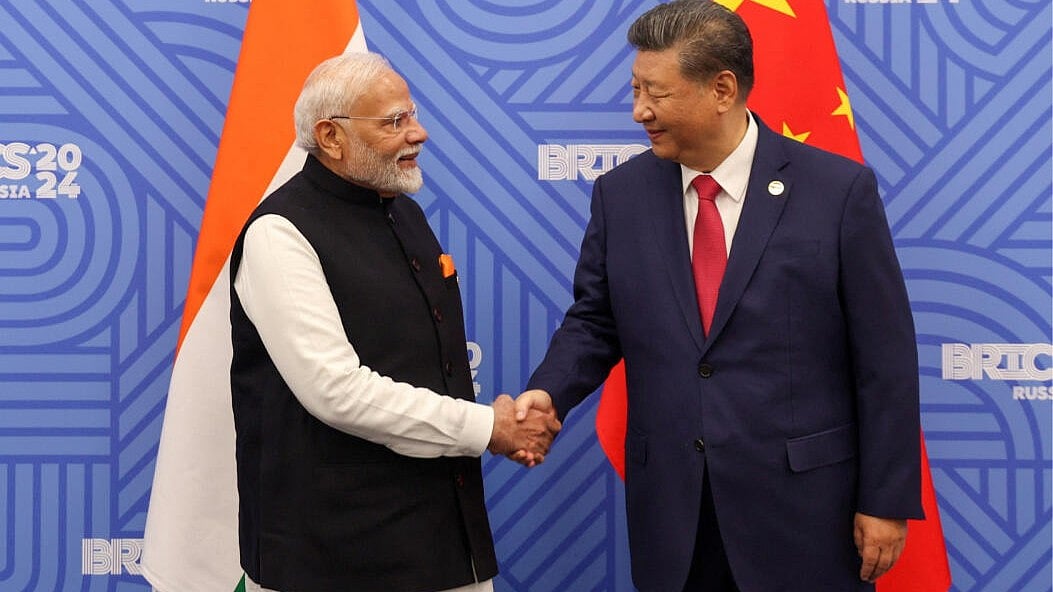
New Delhi: Even as Prime Minister Narendra Modi is likely to host President Xi Jinping soon, New Delhi, of late, has quietly allowed one of the top leaders of the 1989 pro-democracy uprising at Tiananmen Square in Beijin…
New Delhi: Even as Prime Minister Narendra Modi is likely to host President Xi Jinping soon, New Delhi, of late, has quietly allowed one of the top leaders of the 1989 pro-democracy uprising at Tiananmen Square in Beijing to visit India – a move that could irk China. Wang Dan, a well-known critic of the Communist Party of China (CCP), visited the headquarters of the Tibetan Government-in-Exile (TGiE) in Dharamshala, Himachal Pradesh. He was the chief guest at an event marking the 66th anniversary of the launch of the democratic system of governance for the exiled Tibetans in September 1960, just over a year after the 14th Dalai Lama escaped from Lhasa to India, foiling the Chinese People’s Liberation Army’s plan to imprison him. Chinese President Xi Jinping likely to visit India with big delegation for first time in seven yearsThe CCP “relies on violence, lies and control” to continue its rule in China, said Wang, who had been put on a list of 21 “most wanted fugitives” that was issued by the Ministry of Public Security of the communist country’s government following the April-June 1989 protests by students and youths at Tiananmen Square in Beijing. He had also been imprisoned in China for several years between 1989 and 1998 before being released and relocating to the United States.Wang said at the commemorative event in Dharamshala that Chinese pro-democracy activists, opposed to the CCP’s rule and spread around the world, had been working to establish a democratically elected “China Congress” in exile, much like the Tibetan Parliament in Exile (TPiE), which came into existence on September 2, 1960. “We hope to bring democratic practices belonging to the Chinese people, accumulate experience for China’s future democratic transition, and contribute to constitutional development,” the TGiE quoted Wang, an alumnus of both Peking University, China, and Harvard University, US, saying at the event. With Xi likely to visit New Delhi late next week and hold a bilateral meeting with Modi, apart from attending the 18th BRICS summit, India’s move to allow a prominent dissident accused of seeking to overthrow the CPC from power in China is significant.The proposed Modi-Xi bilateral meeting is expected to be another milestone – after the ones at Kazan in Russia in October 2024 and in Tianjin, China in August 2025 – in the efforts by two governments over the past two years to restore normalcy in relations, which had nosedived to a new low after the violent face-off at Galwan Valley in June 2020 and the more-than-four-year-long military stand-off in eastern Ladakh.Beijing has been routinely conveying its concerns over the existence of the TGiE and the TPiE, as well as over the Dalai Lama’s words, tours, and other activities in India. China in the past also objected to the visit of pro-democracy Chinese dissidents opposed to the CPC to India.China had in 2016 persuaded India to cancel the visa issued to Uyghur leader Dolkun Isa, whom it had called a terrorist. Isa, who lives in exile in Munich, Germany, had been planning to attend an interfaith and inter-ethnic conference at the TGiE headquarters in Dharamshala to discuss democracy and peaceful dialogue. He had then been the secretary-general of the World Uyghur Congress, known for its campaign against political, cultural and religious repression of Uyghurs in Xinjiang, China, under CCP rule.Ahead of the Modi-Xi “informal summit” in Wuhan in central China in April 2018, New Delhi had issued an advisory, asking “senior leaders” and “government functionaries” in the states as well as at the Centre to stay away from events attended by the Dalai Lama – ostensibly to avoid irking Beijing and derail the process to mend ties after the 73-day stand-off between the Indian Army and Chinese People’s Liberation Army on Doklam Plateau in western Bhutan.The Dalai Lama set up the TGiE (officially the Central Tibetan Administration or the CTA) on April 29, 1959, just a few weeks after he arrived in India following his escape from Tibet, which had been occupied by the Chinese PLA in 1950-51.The CTA calls itself the “continuation of the government of independent Tibet”.Beijing does not recognise the elections to the Sikyong, the head of the CTA, and the TPiE and repeatedly asks India to shut down the TGiE. It has been accusing the Dalai Lama as well as the TGiE of running a secessionist campaign against China.New Delhi officially never acknowledged the existence of the TGiE or the CTA. But it did tacitly encourage the Dalai Lama to lead the exiled community to embrace democracy gradually – starting with electing the TPiE and then moving on to directly elect the leader of the TGiE. It was during the 2011 elections that the Dalai Lama officially announced that he would be delegating his political powers to whoever would be elected democratically to the top office of the TGiE – a move apparently aimed at avoiding a leadership vacuum and keeping the struggle against China’s rule in Tibet alive beyond the lifetime of the nonagenarian monk.The 14th Dalai Lama on July 2, ahead of his 90th birthday, not only confirmed that the institution of the Dalai Lama would continue beyond his lifetime but also announced that no one else but the Gaden Phodrang Trust, based in India, would have the sole authority to recognise his future reincarnation. He had earlier said that his reincarnation would be found in the ‘free world’, not in Tibet under the occupation of China.Beijing strongly reacted to his statement from India, stating that the reincarnation of the Dalai Lama, the Panchen Lama and other great Tibetan ‘Living Buddhas’ must be chosen by the traditional practice of drawing lots from a ‘Golden Urn’ and the choice must be approved by the central government of China.
Source: Deccan Herald
🔑 Key Takeaways
- Wire dispatch directly ingested from deccanherald.
- Published at Sat, 05 Sep 2026 17:24.
- Source URL: https://www.deccanherald.com/india/ahead-of-modi-xi-meet-delhi-lets-tiananmen-square-uprising-leader-visit-india-slam-chinas-communist-party-4136514