
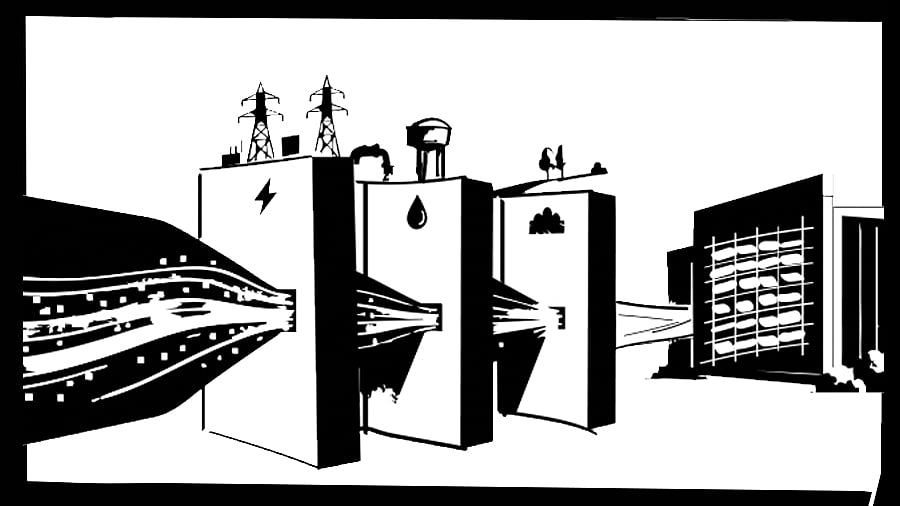
Build, power, cool: India’s data centre mantra
India’s data centre boom has entered a new phase. In its nascent phase of development, competition for data centres was largely confined to a handful of established hubs such as Mumbai, Chennai, Hyderabad, and parts of the National Capital Region. While that geography is expanding rapidly and several Indian states are competing aggressively for data centre investments, all of them rely on the same playbook: concessional land, stamp-duty exemptions, electricity subsidies, tax concessions, and faster approvals. But as India enters a more mature phase of its data centre evolution, such incentives are becoming less important. The decisive competition will be over something much harder to replicate: physical infrastructure, including dependable electricity, adequate water supply, contiguous land, accessibility, and connectivity.TCS’ HyperVault to build 1 GW capacity AI data centre campus in HyderabadIPC proposes Rs 17,000 crore green data centre in TumakuruGoogle-Adani’s $15 billion data centre project in Andhra Pradesh battles water, wildlife concernsThree recent developments illustrate how rapidly the sector is changing. In the first week of August, Microsoft opened its largest India data centre region in Hyderabad. Around the same time, the Ministry of Electronics and Information Technology (MeitY) informed the Lok Sabha that India’s installed data centre capacity had expanded from about 375 MW in 2020 to roughly 1,575 MW, with new investment destinations emerging in Andhra Pradesh, Madhya Pradesh, Chhattisgarh, and West Bengal. Parliament also passed amendments that simplify access to tax reliefs available to foreign companies procuring data centre services, with the exemptions slated to continue until 2047. As a result of these amendments, the importance of marginal state-level tax incentives has diminished, and a major component of data centre economics is now determined at a national level rather than by individual states.This changes the economics of state competition. A subsidy is valuable only to the extent that competitors cannot match it; moreover, most fiscal incentives are relatively easy to replicate. Once policies converge, their ability to differentiate between locations diminishes and therefore, physical infrastructure becomes the crucial bottleneck. The question for states is no longer whether they can attract a data centre but whether they can sustain the operations of a large infrastructure and resource-intensive behemoth.Data centres are often described as digital infrastructure, but their success depends deeply on physical infrastructure. Behind the cloud lies concrete, steel, substations, transmission lines, water pipelines, and industrial land. What matters to an operator investing billions of dollars is not the subsidy available at the launch but the reliability of operations over decades. Therein, the trade-offs involved in choosing potential data centre locations reveal themselves with three constraints increasingly standing out: electricity, water, and land parcels.Modern hyperscale facilities require enormous quantities of steady power delivered in a fail-safe manner. Unlike many industrial operations, data centres cannot tolerate interruptions. While generators and backup systems can manage short-term failures, large investors value locations where round-the-clock supply can be guaranteed, transmission capacity can be expanded, and renewable energy procurement can scale alongside demand. The distinction between generating and delivering stable power is crucial because transmission bottlenecks can prevent a state, even one with abundant generation, from catering to a large and constant load.The second constraint is water. Although cooling technologies continue to evolve and operators are investing in more efficient systems, data centres remain significant consumers of cooling resources. As artificial intelligence workloads increase computing density, cooling requirements become even more critical. Locations that can provide dedicated and predictable water availability will enjoy a major advantage. Andhra Pradesh has substantial groundwater resources: the Central Ground Water Board estimates annual extractable groundwater resources at 26.41 billion cubic metres, and 87% of its groundwater assessment units are classified as safe. But such aggregate numbers can be misleading. Water is a local resource, and the relevant question is whether a particular data centre site has dedicated access without creating conflict with urban or agricultural needs.Next comes land, which may prove to be the most decisive factor. A hyperscale data centre requires large contiguous tracts of land, with proximity to high-capacity power infrastructure, appropriate zoning restrictions, road connectivity, access to fibre optic networks, separability from urban environments, and room for future expansion. The India Industrial Land Bank currently maps 4,242 industrial parks and more than 100,000 hectares of industrial land available nationally, but the challenge is not the aggregate quantity of land; it is finding the right parcel in the right location with the right infrastructure.Nevertheless, states with large, pre-assembled industrial land banks will likely have a structural advantage over cities where land is fragmented and increasingly expensive. Once industrial corridors, power connectivity, and transport access are built around a location, it translates into a sustained competitive advantage. This is why land is the hardest competitive position to reverse: while a state can announce a new incentive package in a matter of weeks, what it cannot imbue is hundreds of acres of suitably located industrial land connected to a robust power grid.A national visionUnderstanding these constraints provides a forward-looking approach for India. Rather than encouraging every state to compete with increasingly generous incentives, formulating a national framework for data centre zones based on measurable infrastructure capacity and accurate projections of constraints is the real need. States should be assessed on power availability, transmission redundancy, adequacy of water supply, land suitable for phased expansion, fibre connectivity, and scalable access to renewable energy.India should avoid concentrating all its data centre capacity in a handful of locations. The objective should be to establish a network of “data centre corridors”, as geographic diversification captures significant economic and resilience benefits.If the first phase of India’s data centre race was about attracting investments, the second will be all about rising up to meet capacity requirements. In the long run, capability beats incentives; the race will be decided not in policy documents but in India’s ability to execute the building, powering, and cooling of data centre campuses for the next twenty years.The writers teach at the Indian Institute of Management Bangalore.(Disclaimer: The views expressed above are the author’s own. They do not necessarily reflect the views of DH.)
Source: Deccan Herald
🔑 Key Takeaways
- Wire dispatch directly ingested from deccanherald.
- Published at Tue, 08 Sep 2026 20:48.
- Source URL: https://www.deccanherald.com/opinion/build-power-cool-indias-data-centre-mantra-4139757