
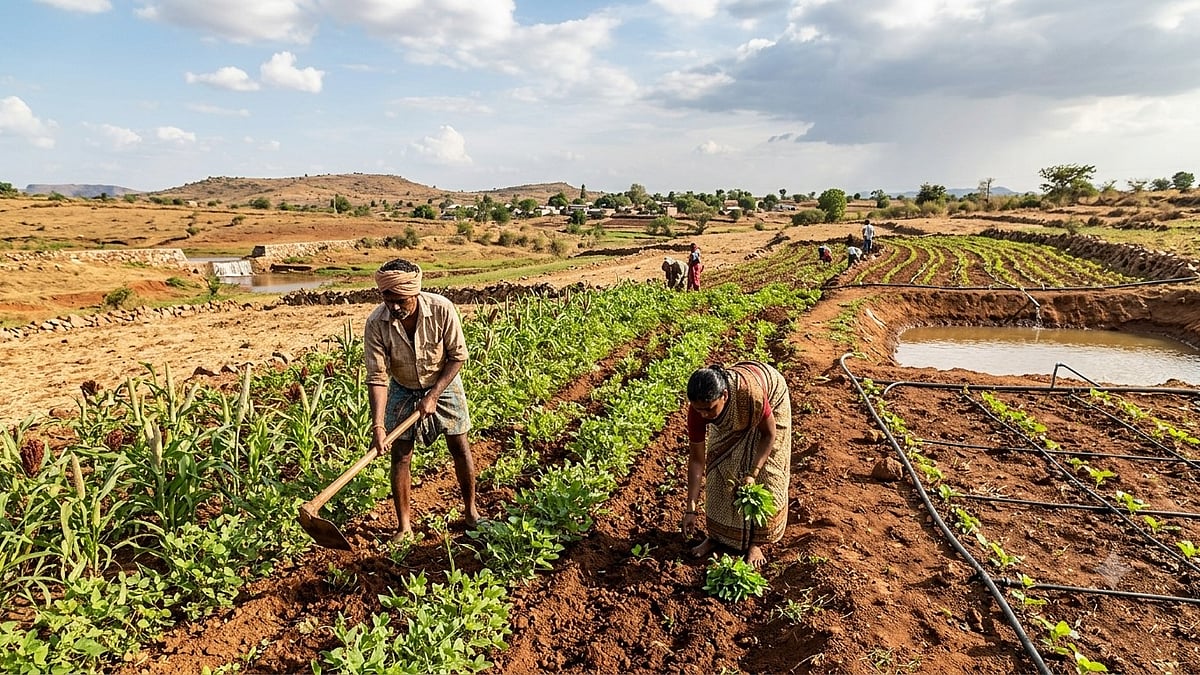
Climate-smart cropping
The need for change in cropping patterns is growing due to uncertainty in rainfall, particularly in the dry and rainfed areas of India’s southern states. The actual cumulative rainfall (787.4 mm) was above the normal rainfall (716.2 mm) during June-September 2025 of the south-west monsoon in the southern states. State-wise rainfall data reveal that actual rainfall was above normal in Andhra Pradesh, Telangana, and Karnataka, while it was low in both Kerala and Tamil Nadu. In sharp contrast, the South Peninsula has received 129.3 mm against a normal of 161 mm in June, indicating a 20% deficit, while the cumulative rainfall as of July 29 was 259.7 mm against a normal of 353.1 mm, reflecting an overall deficit of 26% driven by strengthening EL Niño conditions.Low and erratic rainfall severely reduces agricultural crop yields, delays sowing, and affects rural livelihoods, food security, and groundwater levels. Though the manufacturing and service sectors contribute more to the GSDP of these states, agriculture is still the livelihood for the majority of the workforce. Around 55-60% of the workforce depends on agriculture in Andhra Pradesh, followed by 50-55% in Telangana, 45-50% in Karnataka, 40-45% in Tamil Nadu, and 25-30% in Kerala. Kerala has a more diversified workforce with greater dependence on manufacturing and services.Given this, it is vital to adopt location-specific technologies that match changes in cropping patterns to counter the adverse effects of climate change and soil degradation in agriculture, especially in dryland and rainfed areas of these states, where the risk of crop failure is high. The farmers in the dry and rainfed areas of these states produce crops that require relatively less rainfall, such as pulses, millets, oilseeds, and cotton.However, trends in market prices, traditional cropping patterns, soil, and agro-climatic conditions in the specific regions of these states play a major role in selecting crops: Rayalaseema and parts of coastal districts were identified as rainfed areas in Andhra Pradesh; districts located in the southern Telangana zone, like Nalgonda, Jogulamba Gadwal, Wanaparthy, Nagarkurnool, and Narayanpet; north Karnataka; interior districts in Karnataka; Ramanathapuram, Sivaganga, Virudhunagar, Tirunelveli, Dharmapuri, Salem, and Tuticorin in Tamil Nadu; and uplands in Kerala.Soil moisture-holding capacity and rainfall availability are the two important factors to consider when selecting crops in dryland and rainfed areas of these states. The soils that are best suited for the production of various crops are as follows: very dry/light soils for bajra; dry black/red soils for jowar; black/red soils for redgram; sandy/red soils for groundnut; light soils/dry conditions for sesame; dryland black/red soils for sunflower; and extremely dry areas for horsegram.Intercropping is also suitable in dryland and rainfed areas, based on the availability of short-duration varieties; appropriate nutrient management, spacing, and plant population; adequate market demand; and crops with different root depths and durations. Suitable combinations may include bajra (pearl millet) with red gram, foxtail millet with red gram, ragi with red gram, groundnut with red gram, and sorghum with pigeon pea.Explained | Why a super El Niño leaves tropical commodities acutely exposedTechnologies like watershed development, micro-irrigation, and satellite-based drought monitoring are particularly suitable for Andhra Pradesh. Farm ponds and check dams, microirrigation, and soil moisture sensors are appropriate for Telangana. Watershed management, drip and sprinkler irrigation, and remote sensing for drought monitoring are well-suited to Karnataka. Microirrigation, precision agriculture, and solar-powered irrigation are suitable for Tamil Nadu. Technologies that should focus on rainwater storage, drainage management, and climate-resilient cropping are relevant to Kerala. The application of location-specific technologies would enhance crop productivity, water-use efficiency, soil health, and farmers’ incomes in rainfed areas.In southern states, the challenge is not merely inadequate rainfall; its uneven distribution is an equally important concern. Depending on the agroclimatic conditions, the focus should be on raising awareness among farmers about the transition from water-intensive crops to millets, pulses, oilseeds, fodder crops, etc. Crop diversification can be encouraged in dry and rainfed areas by providing various economic incentives, an assured market, quality seeds, access to water conservation technologies, and crop insurance to farmers.Farmer-producer organisations must play a major role in providing access to inputs, location-specific technology, credit, and market access to small and marginal farmers, enabling them to diversify from water-intensive crops to crops suited to local agro-climatic conditions.(The writer is a financial and economic expert)Disclaimer: The views expressed above are the author’s own. They do not necessarily reflect the views of DH.
Source: Deccan Herald
🔑 Key Takeaways
- Wire dispatch directly ingested from deccanherald.
- Published at Sun, 23 Aug 2026 22:35.
- Source URL: https://www.deccanherald.com/india/climate-smart-cropping-changing-cropping-patterns-amid-uncertain-rainfall-4121620