
Food must not
depend on a face
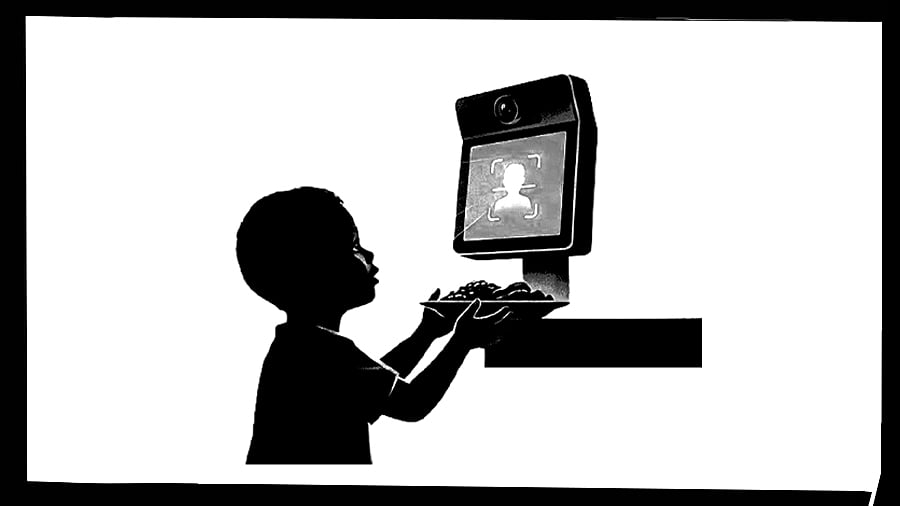
Neetu SharmaSomewhere in Jharkhand, a four-year-old waits each morning at her Anganwadi centre for her meal. According to the Government of India’s Poshan Tracker, the app that now decides who eats, she does not exist. Her birth certificate, issued by a private hospital, is not recognised by the government. Without it, she cannot get an Aadhaar number, and without Aadhaar, she cannot enrol for food. Her exclusion has nothing to do with hunger and everything to do with an algorithm.This is not a glitch; it is policy. Over the past 18 months, the Ministry of Women and Child Development has embedded a Facial Recognition System (FRS) into Poshan Tracker to authenticate every beneficiary of the Take-Home Ration scheme — pregnant women, lactating mothers, adolescent girls, children as young as six months old. Karnataka has gone further, approving ‘Nirantara’, an AI facial-attendance system linking a child’s face to the release of mid-day meals, eggs, milk, and shoes. Two of India’s largest child welfare programmes are now, literally, unlockable only by a face.The government’s case sounds reasonable: eliminating ‘ghost’ beneficiaries and ensuring transparency in a system serving nearly 8.9 crore people. Face capture among registered beneficiaries rose from 68.98% in July 2025 to 97.01% by February, the Ministry reports. But enrolment statistics measure photographs captured, not meals delivered.Food safety: Karnataka govt mulls setting up taluk level watch teamsWhat the numbers cannot tell usA Decode/Pulitzer Center investigation across Bihar, Jharkhand, and Karnataka found children cut off from meals and health monitoring because facial verification could not match their mothers’ current faces to years-old Aadhaar photographs, altered by pregnancy, illness, or time. Since children under six are verified through a parent, a mother’s failed face-match silently deletes her child from the rolls. These children go hungry not for lack of resources, but a technical error — poor lighting, a lost network signal, a face that has changed — treated by the system as proof of fraud.Is this legally mandated?Beyond the human cost, the FRS rests on no clear legal basis. A Right to Information inquiry by the Internet Freedom Foundation found no protocol for authentication failure, no Data Protection Impact Assessment, and no independent security audit. The ministry confirmed a six-district pilot in August 2024 and a ‘not mandatory’ nationwide rollout in December 2024, which within months was made fully mandatory, with no evaluation or public consultation such a change should demand.In Puttaswamy (2018), the Supreme Court held that no one may be denied an entitlement for a failed authentication, and directed that alternatives be offered when biometrics fail. In the Poshan Tracker, facial recognition is mandatory and offers no alternative. The Bombay High Court said much the same, more bluntly, ordering foodgrain released regardless of Aadhaar-linking problems and holding that technology cannot override a fundamental right. In Karnataka, civil society groups and parents have written to former Chief Minister Siddaramaiah urging withdrawal of Nirantara, arguing it turns a child’s safest space into a site of biometric surveillance.Whose rights are at stakeArticles 3, 24, and 27 of the Convention on the Rights of the Child require the State to treat a child’s best interests as paramount and guarantee non-discriminatory access to nutrition; making a toddler’s ration contingent on her mother passing a facial scan sits uneasily beside that duty. Article 11 of the International Covenant on Economic, Social and Cultural Rights (ICESCR) requires States to ensure food security unconditionally, not conditional on network strength or camera quality. The right to life with dignity, upheld in PUCL vs Union of India, is compromised whenever an entitlement is withheld because a face-match failed. The FRS is a verification tool; it cannot become the end in itself.Saving face? The pros and cons of having facial recognition everywhereLeakage is real, but a decade of biometric authentication in the Public Distribution System offers a warning. Aadhaar-based fingerprint authentication, compulsory since 2016, excluded widows, the elderly, and people living alone at sharply higher rates. A 2020 J-PAL study found 88% of the 1.44 lakh ration cards cancelled in Jharkhand under this system belonged to genuine, eligible households. The Right to Food Campaign has documented authentication failures preceding starvation deaths. Infants without a stable facial template, and mothers whose faces have changed through pregnancy or age, face the greatest risk.What happens to India’s largest child-nutrition database, the biometric records of millions of children held on cloud infrastructure, remains unclear even to Parliament. The Digital Personal Data Protection Act, 2023 grants children’s data special safeguards but exempts government welfare delivery, hollowing out protection precisely where it matters the most. Consent here is a formality: a hungry family cannot meaningfully decline.What withdrawal would meanNone of this argues against improving efficiency. It argues that technology causing silent, disproportionate exclusion must be tested and safeguarded before being made mandatory. A constitutionally recognised right to food cannot hinge on a system with real chances of failing. If the FRS must be used, it should be one verification channel among several, with offline alternatives guaranteed on failure.Karnataka’s Nirantara programme is still in its early stages, leaving a window to correct course. Parents and civil society groups have made the ask explicit: demonstrate necessity and proportionality, publish the withheld accuracy and failure-rate data, and guarantee that no child’s meal or education depends on whether a camera recognises their mother’s face on a given morning. Until the State can show its technology is reasonably accurate for the populations it serves, the burden of proof belongs with the system, not with the four-year-old waiting for her lunch.(The writer has worked at the Centre for Child and the Law, National Law School of India University, Bengaluru for more than two decades)(Disclaimer: The views expressed above are the author’s own. They do not necessarily reflect the views of DH.)
Source: Deccan Herald
🔑 Key Takeaways
- Wire dispatch directly ingested from deccanherald.
- Published at Sun, 23 Aug 2026 22:10.
- Source URL: https://www.deccanherald.com/opinion/when-a-face-match-decides-who-eats-4121623