
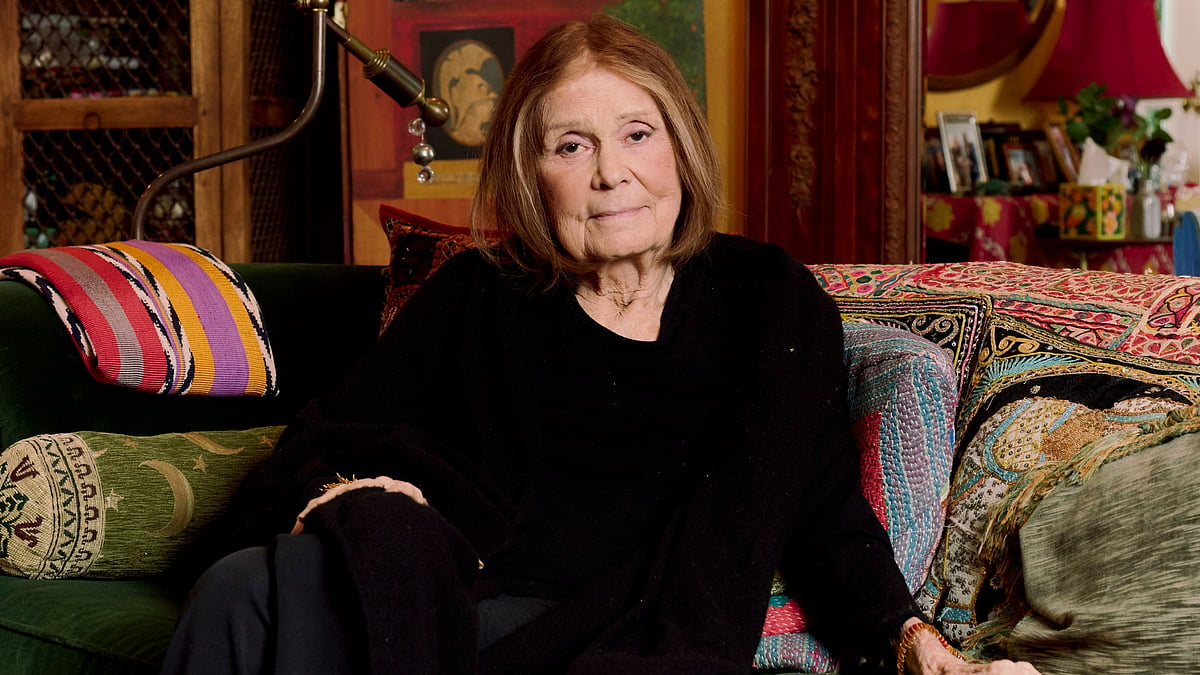
Gloria Steinem: Revisiting the feminist icon
Last week, as the familiar warm afternoon in Bengaluru slowly blended into the softness evenings bring, a notification popped up on my phone. American feminist and activist Gloria Steinem, 92, had passed away. I sent a text to a friend about it, who replied with “Who is that?” It’s almost ironic because a few months ago, the same person had sent me an Instagram reel with a quote: “We are the women our parents warned us against, and we are proud.” These words were Gloria’s.It’s a peculiar thing that often happens with writers: with time and age, their names slip through the cracks of memory and weakening attention spans, but their words keep appearing like waves, pushed to shore by relevance. Gloria’s words remain such, continuing to hold onto contemporary importance.Born in Toledo, Ohio, in 1934, Gloria witnessed her parents’ divorce ten years later, leaving her to take care of her mother, who was ill. Decades later, Gloria said she “became a grown-up too early, from ten to 17, a small person responsible for a big person.”Feminist activist Gloria Steinem dies at age 92Finding home in IndiaIn her student days, she spent two years studying in India after receiving the Charles Bowles Fellowship in the late 1950s. In the book, As If Women Matter: The Essential Gloria Steinem Reader, she recalls feeling “more at home and involved [in India] than I ever had in any other country not my own.” For a brief period, she spent her time at Delhi University’s Miranda House. In the book, she talks about wearing saris, as seen in some photos, including one wherein Gloria is clad in a sari for an advertisement in 1958, and learning that ‘radical’, a word that would often be used for her years later, didn’t have to mean “violent, extremist, or crazy” but could be about “going to the root.”Gloria in a sari. In 1963, she went undercover to expose the abhorrent working conditions of women in Hugh Hefner’s Playboy Club. The story opened doors to mainstream media, with her eventually becoming a columnist for New York Magazine.In April 1969, working as a journalist, she covered an “abortion speak out event” which she later said became “a turning point in my consciousness.”In 1971, to break the glass ceiling that had made journalism a boys’ club, she co-founded Ms Magazine, bringing her idea of feminism to the newsstands. At a time when the general perception about women’s reading interests was deeply sexist, focusing on fashion, beauty and housekeeping, Ms Magazine attempted to shift attention towards feminist writing.By the 1970s, she had become one of the most recognisable faces of the feminist movement.Lack of intersectionalityOver the years, she became an entry point to understanding feminism for many. To date, she is considered an icon who stood for reproductive rights, gender equality, equal pay, called out gendered stereotypes, and systemic discrimination that women face every day. However, some of her words and actions have been criticized as problematic and exclusionary.Some black women have called her out and said that when talking about women’s rights, Gloria catered to educated white women and that her feminism had a class and race problem, often leaving out women of colour, Black women, queer women and those in the Global South.She also worked with the Central Intelligence Agency (CIA), where she led the Independent Research Service (IRS), which sent non-communist American students to international youth festivals in Europe.In an interview, Gloria described the CIA as “liberal, nonviolent, and honourable.”In 1998, Gloria also defended Bill Clinton against sexual allegations and in a 1977 essay, she disapproved of gender-affirming surgeries.However, in 2013, she came in support of transgender people and said those who have transitioned are “living out real, authentic lives.”When mourning loss, there is a tendency to see people through the lens of glorified perfection, but it’s important to remember Gloria’s words that “a pedestal is as much a prison as any small, confined space.”
Source: Deccan Herald
🔑 Key Takeaways
- Wire dispatch directly ingested from deccanherald.
- Published at Sat, 12 Sep 2026 23:35.
- Source URL: https://www.deccanherald.com/features/gender/gloria-steinem-revisiting-the-feminist-icon-4143008