
What Karnataka’s domestic violence numbers don’t say
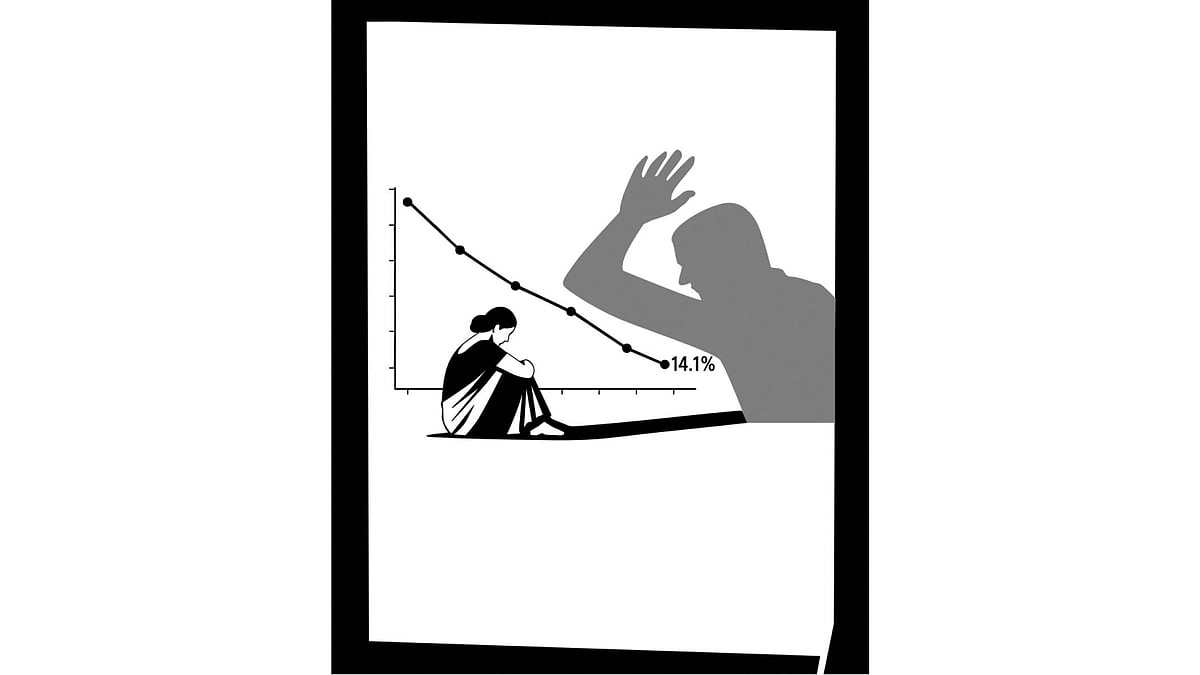
The recently published National Family Health Survey (NFHS) reports a steep drop in the prevalence of spousal violence across Karnataka. According to the data, the share of ever-married women aged 18-49 who reported experiencing physical or sexual violence from a spouse fell sharply from 44.4% in NFHS-5 (2019-21) to 14.1% in NFHS-6 (2023-24), a decline of 30.3 percentage points. Nationally, the fall was far more modest, 29.2% to 22.3%. A second signal points the same way: reported physical violence during pregnancy in Karnataka nearly halved, from 5.8% to 2.9%.The NFHS routinely captures multiple dimensions of violence against women, providing important indicators on physical, sexual, and emotional violence. These include the proportion of ever-married women who have experienced physical or sexual violence by their husbands, specific forms of physical violence, emotional violence, sexual violence, violence during pregnancy, and injuries resulting from spousal violence. The survey also captures help-seeking behaviour among women who have experienced violence and information on whether women have experienced physical or sexual violence from perpetrators other than their husbands. Nationally, the overall trajectory across successive NFHS rounds suggests a gradual, though uneven, decline in several indicators of spousal violence. However, progress has varied considerably across different forms of violence and across states.Karnataka presents a conundrum: prevalence of domestic violence in the state stood at 20.6% in NFHS-4 (2015-16), more than doubled to 44.4% in NFHS-5, and has now fallen to 14.1% in NFHS-6 – a swing of nearly 24 points up, followed by more than 30 points down, in back-to-back survey rounds. Taken at face value, this represents noticeable inconsistency. But we should be cautious about assuming that it is tracking lived experience alone.India promised 6% of GDP for education. Six years after NEP 2020, spending is still stuckA critical consideration is that the NFHS measures reported experience of violence, not the actual occurrence of violence itself.What combination of real change and measurement change could explain the observed decline? Domestic violence is influenced by a complex set of factors, including changing gender norms, women’s access to education and autonomy, economic opportunities, access to information and services, and actual change in perpetration of violence. The Karnataka trend, which shows dramatic change within short time frames, is unusual enough that we need to examine both genuine reductions in violence and changes in disclosure/reporting before drawing conclusions.NFHS-5 and NFHS-6 followed the same broad survey structure, including the sequence and categories of questions. However, consistency in the survey instrument does not necessarily mean consistency in how sensitive experiences are reported. Domestic violence is particularly complex in this regard. Responses can be influenced by the survey environment, interview privacy, the interviewer-participant interaction, how questions are understood in the regional language, and women’s willingness or ability to disclose such experiences. Reporting may also change as women’s understanding of behaviours such as controlling behaviour, coercion, or forced sex evolves. These factors are not unique to Karnataka, but they raise an important question when interpreting changes in domestic violence estimates across survey rounds: how much reflects a true change in the prevalence of violence, and how much may reflect changes in recognition, disclosure, and reporting?Between 2019-20 and 2023-24, could that climate have changed? Could women who might have spoken about violence in 2019 have become more reluctant to do so in 2023? Fear of family consequences, shame, economic dependence, pressure to preserve a marriage, and the belief that reporting will achieve little can all push women towards silence. Gender norms can be internalised so deeply that violence becomes something to endure rather than something to report. This is why a decline in reported violence is not automatically a decline in the actual experience of violence.Another clue is worth examining. In NFHS-6, the reported prevalence of spousal violence in Karnataka was 19.9% among rural women compared with 6.9% among urban women. That gap reminds us that the story is not uniform. A woman’s geography, economic circumstances, access to services, and social environment can shape both her exposure to violence and her ability to seek help.Keralam offers an interesting contrast. The reported prevalence of spousal violence in the state rose from 9.8% to 17.7% between NFHS-5 and NFHS-6 – an 8 percentage point increase. While this rise cannot entirely be ascribed to increased disclosure, it is possible that greater awareness and lower stigma can make women more willing to recognise and disclose violence. If greater willingness to speak can push a number upward, greater reluctance to speak can push it downward – without a corresponding change in the underlying reality.Premature celebrationNone of this means that Karnataka’s progress is illusory. Improvements in women’s education, access to information and digital resources, economic opportunities, awareness of rights, and support mechanisms such as Sakhi One Stop Centres may well have contributed to a genuine reduction in violence. Karnataka’s broader policy environment may also be relevant, including the government’s five-guarantee scheme; however, any contribution from these initiatives should be interpreted cautiously, particularly given the timing of their implementation relative to the NFHS-6 survey period. But “violence has declined” and “violence has fallen by two-thirds” are very different claims.The NFHS-6 figure should therefore be treated as an important signal, rather than a declaration of victory. Access to the full NFHS-6 dataset would allow a deeper analysis of associated factors, including women’s education, mobility, labour force participation, access to information and services, and attitudes towards gender and violence, which could provide greater insight into the possible drivers of this change. Future research should also examine reporting patterns alongside police complaints, helpline use, service utilisation, and women’s awareness and exercise of their rights.Madhumita is a research scientist and assistant professor, Ramalingaswami Centre on Equity and Social Determinants of Health, Public Health Foundation of India; Shreelata is Director and professor at the Centre.(Disclaimer: The views expressed above are the author’s own. They do not necessarily reflect the views of DH.)
Source: Deccan Herald
🔑 Key Takeaways
- Wire dispatch directly ingested from deccanherald.
- Published at Thu, 17 Sep 2026 20:06.
- Source URL: https://www.deccanherald.com/opinion/what-karnatakas-domestic-violence-numbers-dont-say-4150037