
A Nobel for
optogenetics
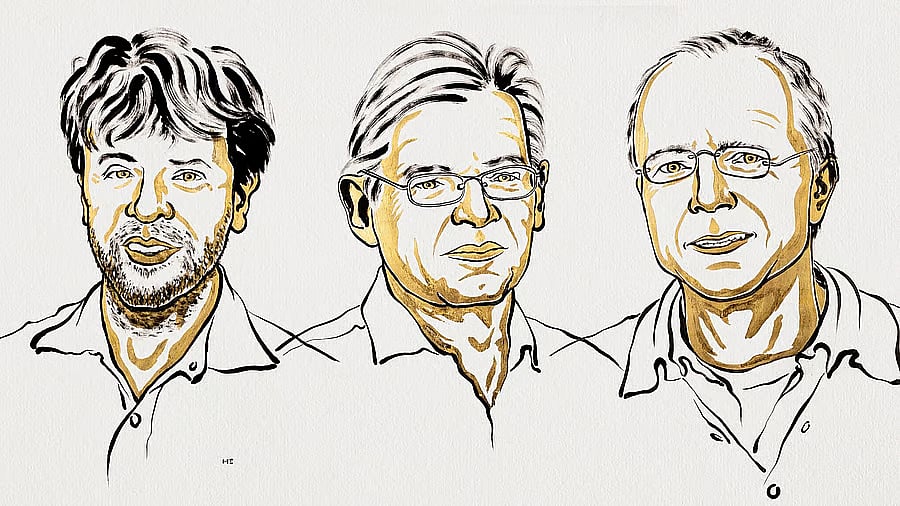
The human brain contains a large number of specialised nerve cells, called neurons, about 86 billion or so. Each such cell can form thousands of connections with other neurons. They receive and transmit information via electrical impulses, storing memories in the strength and complexity of connections between them.Figuring out the circuitry that governs senses such as thirst and pain requires the ability to monitor nerve cells one-by-one. To alter their behaviours, one should be able to purposefully manipulate them. The 2026 Nobel Prize in Physiology or Medicine, awarded jointly to Karl Deisseroth, Peter Hegemann and Georg Nagel, highlights the breakthroughs that make this possible.The brain is a complex organ, but even much smaller, single-celled organisms process information. Chlamydomonas, a single-celled alga, can swim towards a light source. Peter Hegemann first had the idea that a single protein complex on the surface of this alga could both capture light and act as a conduit for charged particles (positively charged ions) to flow, with the second behaviour normally associated with proteins called ion channels. Karl Deisseroth, Peter Hegemann, Georg Nagel win 2026 Nobel Prize in medicineWork by Hegemann and Georg Nagel, together with Ernst Bamberg, then led to the discovery of an ion channel called channelrhodopsin. When the cell is illuminated by blue light, this protein opens up, allowing charged particles on the outside to flow into the cell, creating an electrical impulse. Hegemann and Nagel showed that other types of cells could be manipulated to behave similarly.Enter Karl Deisseroth, who figured out that channelrhodopsin could be used to activate nerve cells in a controlled manner. The technique, called optogenetics, combines the words ‘optical’ and ‘genetics’, since it refers both to the light that must be shone to excite a nerve cell, and to how instructions for making channelrhodopsin proteins, through a specific gene, can be introduced into the genetic make-up of the organism to be studied.Deisseroth first introduced these special ion channels into rat nerve cells. When the cells were exposed to blue light, they reacted immediately, initiating a signal that propagated to other nerve cells they were connected to. In 2005, the same year Deisseroth’s first paper appeared, Nagel and collaborators showed that channelrhodopsin could also control a living animal, the worm C. elegans. Soon more proteins were found that could be activated – or silenced – by different wavelengths of light.Deisseroth’s group then used these methods to promote wakefulness in sleeping mice. They went even further, introducing this special protein into a specific nerve cell type in the area that governs movement. Illuminating these cells with a thin optic fibre fed into the brain through a small hole in the skull allowed them to control movements of the mouse whisker.The ability to control the activity of specific nerve cells was a milestone. In 2009 Deisseroth and collaborators used optogenetics to understand how deep brain stimulation might produce therapeutic benefit in Parkinson’s disease. Later, his group showed how the effects of stress-induced depression in mice could be removed using such techniques.As with all such prizes, assigning credit is often not easy.The China-born Zhuo-Hua Pan has a claim to have first invented optogenetics. He had the idea that putting a light-sensitive protein into the eye could restore vision in the blind. He submitted his paper to Nature in late 2004, from where it was rejected and then to Nature Neuroscience, which again rejected it. Canadian writer Anne Carson wins 2026 Nobel Prize in LiteratureEarly the following year, he sent the paper to the Journal of Neuroscience, where it was reviewed but then again rejected. By the time it was finally published, in 2006, the paper by Deisseroth had appeared.Another pioneer, Gero Miesenböck at the University of Oxford, was the first to genetically modify nerve cells to make them responsive to light and to use that method to remote-control animal behaviour. He, Bamberg and Edward Boyden, the first author on Deisseroth’s 2005 paper, could arguably have been candidates for the Nobel as well. But the Nobel Foundation’s rules allow no more than three laureates.Questions of priority apart, it’s clear that the ability to activate individual types of nerve cells in the brain has fundamentally changed our understanding of brain wiring and function. The techniques of optogenetics are standard in laboratories now and a part of the toolkit of neuroscience. What lies ahead is exciting: the possibility of using optogenetics and related tools to address questions of disease. And these breakthroughs in the ability to manipulate neural circuits via optogenetics have paralleled the advancement of new technologies, such as viruses that can deliver genes to certain types of cells but not others.What we know as artificial intelligence (AI) today indeed began as an attempt to understand and mimic how the brain stores and processes information. This year’s Nobel Prize celebrates one more step towards that goal.The writer is a professor, Departments of Physics and Biology, Ashoka University, Delhi-NCR.(Disclaimer: The views expressed above are the author’s own. They do not necessarily reflect the views of DH.)
Source: Deccan Herald
🔑 Key Takeaways
- Wire dispatch directly ingested from deccanherald.
- Published at Thu, 08 Oct 2026 20:01.
- Source URL: https://www.deccanherald.com/opinion/a-nobel-for-optogenetics-4175662