
AI’s fair use cannot
skip the liability test
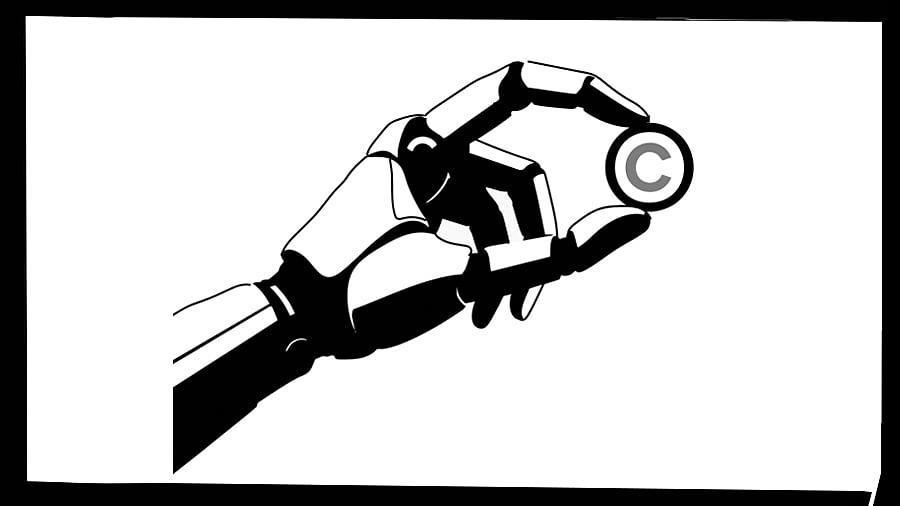
A division bench of the Delhi High Court recently issued notice in an appeal instituted by Asian News International (ANI) against an interim order in its civil suit against OpenAI. The order under appeal refused to restrain OpenAI, the American Artificial Intelligence (AI) corporation that runs ChatGPT, from training its large language models (LLMs) on ANI’s copyrighted work. The appeal will doubtless be limited to the question of whether OpenAI is violating the Copyright Act, 1957. But its implications go beyond the narrow confines of the dispute.When ANI sued in November 2024, it did so on two counts. First, it asserted that OpenAI had scraped and stored its news reports to train the models underlying ChatGPT. Second, it claimed that the LLM had reproduced those reports in its answers. On the second claim, the single judge held in favour of OpenAI, finding that the instances which ANI had produced post-dated the models’ training cut-offs.The first claim is of greater salience. On that, the court held that OpenAI’s storage of ANI’s work for training purposes was protected by Section 52(1)(a) of the Copyright Act, which provides that a “fair dealing” with any work for the purposes, among other things, of “private or personal use, including research” shall not constitute an infringement of copyright.That the use might constitute research of some kind may not be especially debatable. The court reasoned that research is ordinarily a closed, intermediary activity, and that training a model could well be seen as “a form of research for generating new knowledge.” The court was candid about the difficulties it faced. When Section 52 was last amended in 2012, the legislature, Justice Amit Bansal wrote, could not have imagined the advent of AI.The court’s finding that OpenAI’s research was for private use is rather more controversial. The judge relied on the Supreme Court’s judgment in Academy of General Education, Manipal v. B. Malini Mallya (2009), where it found that a ballet performed at an educational institution constituted private use. “Open AI stores the literary works in a closed space without access to the public,” wrote Justice Bansal. “The said data is not publicly available to any human entity either for access or for download. Therefore, in my opinion, the use amounts to being purely private.”This finding is harder to justify. Section 52(1)(a)(i) is only concerned with what a dealing was for. It does not require an examination of who can see the file afterwards. In this case, the actual deployment of data may well be secretive, but it scarcely follows that the use is therefore a private one. The judgment in Malini Mallya related to a dance before a non-paying audience at a college. There was no element of commerce at stake. Here, however, the data is put to an ultimately commercial purpose.For something to constitute fair dealing, it must not only be restricted to the purposes itemised in the statute; the dealing must also be fair. To determine the fairness of the use, the court asked itself three questions: whether OpenAI’s use of the plaintiff’s copyrighted work was limited to training its LLMs; whether the usage resulted in any economic competition to the detriment of the plaintiff; and whether the functions performed by ChatGPT served the overall public interest.In ruling in ChatGPT’s favour on the third of these, the court found that the LLM aided scientific research, technological innovation, and access to information, and therefore conformed to “the broader constitutional and statutory commitment to advancing knowledge and learning.” But as the economist Joseph Stiglitz writes in the Financial Times, what a model produces depends on what goes into it. So, if the enterprises producing that material lose the revenue to keep producing it, there will eventually be nothing worth training on.As Stiglitz says, “What AI is doing goes well beyond fair use of others’ intellectual property.” But the concerns do not end here.The accountability questionSection 79 of the Information Technology Act, 2000, exempts an “intermediary” from liability for third-party content it hosts. Whether that protection extends to an LLM, which does not so much host material as generate it, remains unsettled. Asked precisely this in the Lok Sabha in July this year, the Minister of State for Electronics and Information Technology said the answer “depends upon the nature of the service provided, the functions performed by such system or service”. Therefore, nearly four years after these products entered India, the government still cannot say whether their makers are responsible for what these systems produce.The rest of our legal architecture governing AI is even thinner. In the AI Governance Guidelines published last November, the Centre sets out a list of voluntary commitments, preferring this lighter touch to anything a statute might require. India is not alone in this. Even the European Union has put off the high-risk obligations under its AI Act to December 2027 and withdrew its proposed AI Liability Directive last year.Earlier this week, on the sidelines of the United Nations General Assembly, 22 countries released a joint statement titled ‘A Call for Control of Frontier AI Models’, citing “serious risks to safety and security”.The real gap in our laws is the absence of a liability regime governing what these systems do. Our statutes commonly turn on a state of mind – intention, knowledge, recklessness, foreseeability. But an AI model has none of these. It simply acts. Or, as Stiglitz puts it, “AI ‘agents’ just do; the word ‘intent’ does not apply.”Much as our lawmakers might fear that regulation will harm the growth of AI in India – especially of our own home-grown LLMs – the development must still be grounded in constitutional commitments. It is time we realised our laws, as they stand, are ill-equipped to deal with not only what lies ahead but what is already among us.(The writer is an advocate practising in the Madras High Court)
Source: Deccan Herald
🔑 Key Takeaways
- Wire dispatch directly ingested from deccanherald.
- Published at Tue, 29 Sep 2026 19:33.
- Source URL: https://www.deccanherald.com/opinion/ais-fair-use-cannot-skip-the-liability-test-4164524