
By S SrutiThere is something almost paradoxical about the Indian Left today. Its electoral footprint has rarely been smaller. Yet when political disputes spill out of Parliament and onto the streets, the red flags have a…
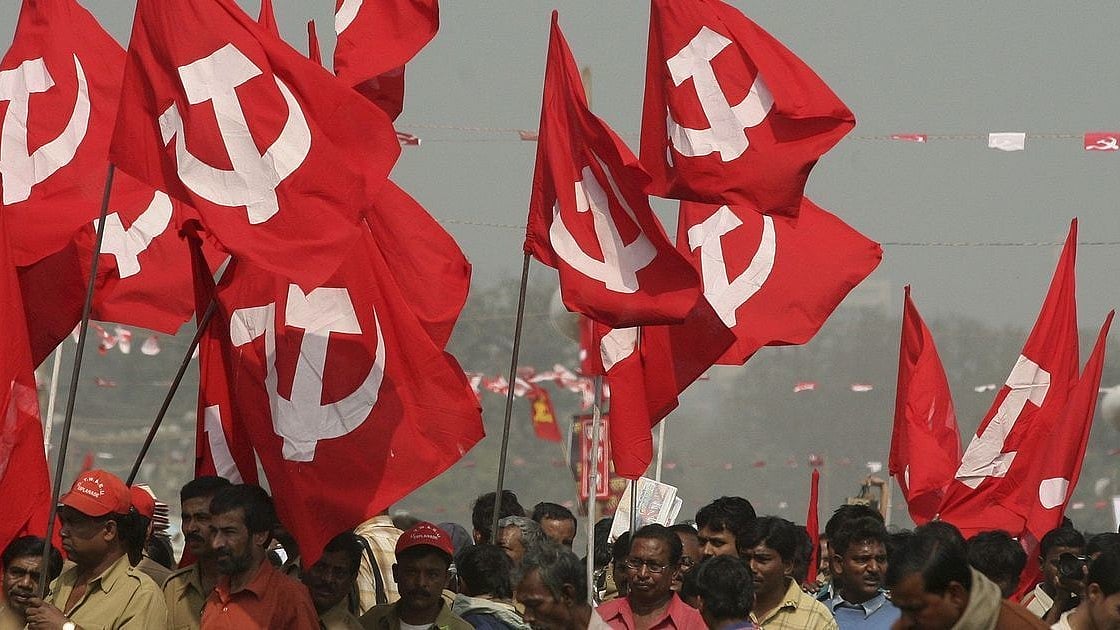
By S SrutiThere is something almost paradoxical about the Indian Left today. Its electoral footprint has rarely been smaller. Yet when political disputes spill out of Parliament and onto the streets, the red flags have an uncanny habit of turning up. The confrontation with the Election Commission is the latest example.Five Left parties namely the CPI(M), CPI, CPI(ML) Liberation, RSP and Forward Bloc have launched a nationwide agitation demanding the removal of Chief Election Commissioner Gyanesh Kumar and a halt to the Special Intensive Revision of electoral rolls. CPI(M) general secretary M A Baby and Brinda Karat were among those detained outside the Election Commission headquarters. Rajya Sabha MPs A A Rahim and V Sivadasan were also detained during an SFI-DYFI protest demanding Kumar’s removal, while Rahim has remained on the streets as the agitation has widened. CPI leader and Rajya Sabha MP P Santosh Kumar has been another prominent presence in the protests.The allegations being made against the Election Commission are serious, and they remain contested. Opposition parties have questioned the SIR process and the independence of the Commission. The protests have since expanded well beyond the Left, drawing participation from the Congress, AAP, RJD, student organisations and civil-society groups. But there is another story unfolding alongside that controversy.For parties whose parliamentary numbers have fallen so sharply, the Left continues to exercise a presence in protest politics that is considerably larger than its electoral strength. This is also something that is hardly new.Only recently, Rahim, Sivadasan and John Brittas were among the CPI(M) MPs who backed the student agitation over alleged examination irregularities. They went to Jantar Mantar following police action, met protesters and subsequently raised the matter in Parliament. Rahim also moved the Supreme Court over the alleged use of facial-recognition and biometric-surveillance technology during the protests.The issues may change but the method often does not. The Left has traditionally treated Parliament and the street not as two separate theatres of politics but as extensions of each other. An agitation outside Parliament becomes a question inside it. A legislative dispute travels in the opposite direction and becomes a mobilisation outside. The farmers’ movement was perhaps the clearest example. The agitation against the three farm laws eventually became one of the largest political movements India had seen in years. It involved farmers’ organisations of very different ideological persuasions, and no single political formation can plausibly claim ownership of it. But the organisational machinery of the Left, particularly the All India Kisan Sabha (AIKS), became an important part of the Samyukta Kisan Morcha coalition. It was also one of those moments when the role of individual parliamentarians became difficult to separate from the movement outside.K K Ragesh, then a CPI(M) Rajya Sabha MP and an AIKS leader, spent considerable periods at the protest sites around Delhi. Inside Parliament, he challenged the farm Bills, moved amendments and demanded a division vote. Outside, he was involved with the farmers’ mobilisation itself.One episode captures that overlap particularly well. After the violence surrounding Republic Day in January 2021, the farmers’ movement faced one of its most difficult moments. At Ghazipur, the administration moved against the protest site, electricity and water supplies were disrupted and pressure mounted on the protesters to leave. Ragesh was among those who remained at the border alongside the farmers as the confrontation intensified. The Samyukta Kisan Morcha subsequently acknowledged hisintervention.It would be an exaggeration to attribute the revival or survival of a vast farmers’ movement to any one politician. That is precisely why Ragesh’s role is more interesting when viewed as part of a larger political tradition rather than as an individual achievement. He was an MP who seemed unusually comfortable moving between a parliamentary intervention and a protest site.The same instinct had appeared earlier during student protests. Ragesh personally intervened on one occasion when police attempted to take a protesting research scholar into custody. During the CAA debate, he challenged the religious criteria underlying the legislation in the Rajya Sabha. When communal violence broke out in North-East Delhi in 2020, he submitted Rule 267 notices seeking an immediate debate and was also involved with Left organisations undertaking relief and fact-finding work in riot-affected neighbourhoods.This thread continues with his successors, Rahim has stood with protesting wrestlers, travelled to Manipur with a DYFI delegation and visited families affected by demolitions in Bengaluru. Sivadasan’s politics has similarly centred on students, education, unemployment and workers’ rights. The fact that both MPs are now back on the streets over the Election Commission controversy makes the continuity difficult to miss.This is not a new phenomenon rather there are older examples too, P Rajeev took on Section 66A of the IT Act in Parliament years before the Supreme Court struck it down, while K N Balagopal repeatedly raised the concerns of rubber farmers, cashew workers and organised labour. Different issues, but much the same political instinct, take a grievance from outside Parliament and make the institution confront it. That distinction is important in understanding what the Left contributes to Indian politics. The Congress remains the principal national opposition party. Regional parties command far greater electoral strength than the Left across large parts of India. And the campaign against Gyanesh Kumar has now grown into a much wider Opposition and civil-society mobilisation. So this is not an argument that the Left possesses some monopoly over dissent. It does not. What it retains, however, is an organisational culture in which protest is still considered part of the ordinary work of politics rather than an occasional instrument deployed during elections to produce a spectacle for electoral gains. Street politics can become performative and the opposition parties can defend institutions selectively, depending on who controls them. The Left is no more immune to these contradictions than anyone else. Yet democracies require something beyond elections and parliamentary arithmetic. They also require organised groups willing to contest state power between elections through parliamentary recourse, courts, unions, student movements, demonstrations and peaceful protest.That is why the images emerging from the confrontation over the Election Commission matter beyond Gyanesh Kumar himself. The controversy will eventually move on. The courts may adjudicate some of the questions. The Election Commission will defend its decisions and the political parties will calculate what the dispute means electorally. But the larger question will remain. When the hard questions from the Parliament spill onto the streets who picks up the baton.At a time when the Left has fewer MPs and MLAs than at any point in the electoral history of independent India, its leaders continue to appear in struggles far larger than their electoral strength would suggest. Perhaps that is the paradox of the Indian Left today, it has lost much of the power, but it has not lost the instinct to be present when the exercise of power is being challenged.The author is a professor at Shyam Lal College (Evening), University of Delhi. (Disclaimer: The views expressed above are the author’s own. They do not necessarily reflect the views of DH.)
Source: Deccan Herald
🔑 Key Takeaways
- Wire dispatch directly ingested from deccanherald.
- Published at Thu, 08 Oct 2026 08:00.
- Source URL: https://www.deccanherald.com/india/beyond-the-numbers-the-lefts-politics-of-protest-4174748