
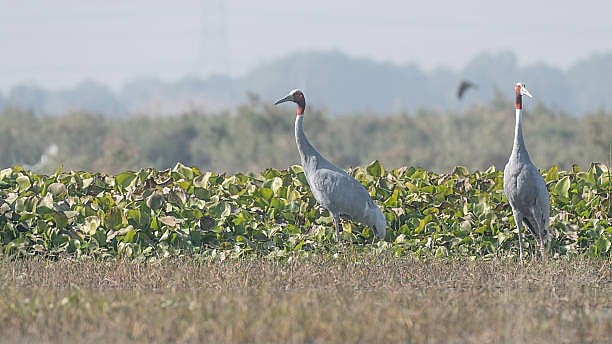
Mumbai: The Bombay Natural History Society (BNHS) has announced a nationwide survey to estimate the population of Sarus Cranes on October 9 and 10, 2026.The survey will be conducted from 6 am to 6 pm on both days. BNHS h…
Mumbai: The Bombay Natural History Society (BNHS) has announced a nationwide survey to estimate the population of Sarus Cranes on October 9 and 10, 2026.The survey will be conducted from 6 am to 6 pm on both days. BNHS has appealed to state forest departments, research institutions, conservation organisations, local communities, farmers, colleges, universities and citizen scientists to visit nearby Sarus Crane habitats and participate in the exercise.“Launching a synchronised All India Sarus Crane Survey will allow us to track their numbers, uncover critical strongholds, and deploy the precise science needed to protect these impressive birds and the landscapes they rely on,” said Kishor Rithe, director of BNHS.Dr P Sathiyaselvem, deputy director of BNHS and head of its Central Asian Flyway Programme, shared details of the survey.The Sarus Crane (Antigone antigone), one of India’s most iconic wetland-associated birds, is the world’s tallest flying bird, standing about 1.5 metres tall. Deeply embedded in the cultural and ecological heritage of the Indian subcontinent, it is regarded as a symbol of lifelong devotion and marital fidelity. It is also India’s only resident breeding crane species.The species is listed as vulnerable on the International Union for Conservation of Nature (IUCN) Red List. It is included in Appendix II of the Convention on International Trade in Endangered Species of Wild Fauna and Flora (CITES) and protected under Schedule I of India’s Wildlife (Protection) Act, 1972, which provides a high level of legal protection.The Sarus Crane depends on a mosaic of wetlands, marshes, shallow water bodies, grasslands and agricultural landscapes. Protecting its habitat also supports wetland conservation, agricultural biodiversity and other species that depend on these ecosystems.Siberian cranes skip India for quarter of a century, no hopes of coming againShrinking rangeHistorically, the Sarus Crane was widely distributed across the Indian subcontinent, particularly the Gangetic plains and adjoining regions, including Uttar Pradesh, Bihar, Rajasthan, Gujarat, Madhya Pradesh, West Bengal and Assam. Historical accounts also indicate a wider presence in central and eastern India.Today, the species has disappeared from or become extremely scarce in several parts of its former range. Its populations are now concentrated largely in agricultural and wetland areas of Uttar Pradesh, Gujarat, Rajasthan, Madhya Pradesh and Haryana, with isolated populations in Maharashtra. While central and northern India remain important strongholds, populations in southern India are experiencing significant declines.Over the past three generations, the species is suspected to have suffered a rapid population reduction that may have exceeded 30% to 40%.An earlier international assessment estimated India’s Sarus Crane population at around 8,000 to 10,000 birds, with numbers declining. However, these historical estimates cannot be directly compared with present-day state counts because survey methods, geographical coverage, seasons and counting efforts have varied considerably.More recent state-level assessments indicate that significant populations remain. Uttar Pradesh, for instance, reported nearly 20,000 Sarus Cranes in its 2024 statewide count, highlighting the state’s importance as a stronghold for the species.The differing estimates underline the need for a standardised, synchronised nationwide assessment to establish a reliable baseline for tracking population trends and identifying priority habitats.The State of India’s Birds report has recorded a long-term population decline of 76.84% for the Sarus Crane, with the current annual trend indicating a decline of 4.33% a year.BNHS said the nationwide survey will help map population trends, identify critical habitats and guide targeted conservation measures for the species.
Source: Deccan Herald
🔑 Key Takeaways
- Wire dispatch directly ingested from deccanherald.
- Published at Fri, 09 Oct 2026 09:34.
- Source URL: https://www.deccanherald.com/india/maharashtra/bnhs-to-conduct-first-synchronised-nationwide-sarus-crane-survey-4176339