
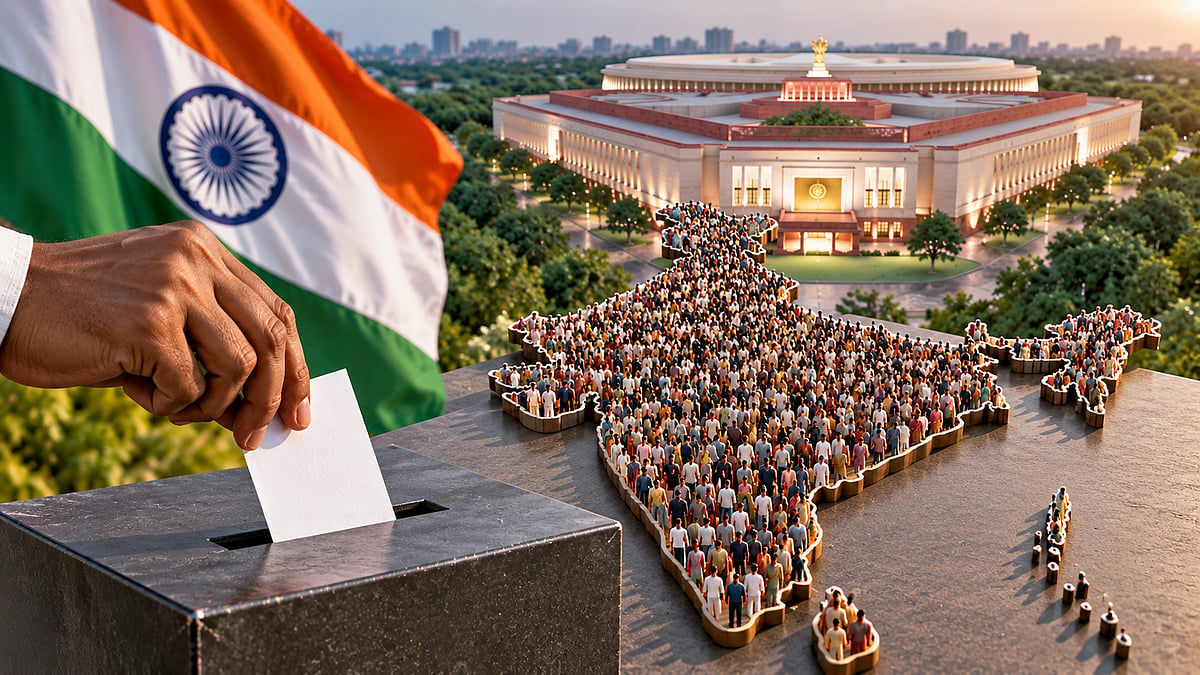
Delimitation and the complex measure of India’s federalism
Democracy begins with a deceptively simple proposition: one citizen, one vote. But what happens when the number of citizens changes dramatically?India is about to confront one of the most consequential questions in the history of its republic. After more than five decades during which the allocation of Lok Sabha seats between states has effectively remained frozen, the country is preparing to revisit the relationship between population and political representation. At first glance, the principle appears unassailable. Yet, what if some states consciously reduced fertility, invested in women’s education, improved health, and achieved demographic stability – while in others, the population continued to grow rapidly? Should a state be politically rewarded for having a larger population and, conversely, penalised for succeeding in controlling population growth?The government has argued that the southern states will not lose political representation. Indeed, under the broad proposal discussed in Parliament, the number of Lok Sabha seats attributed to the south would rise from 129 to 195, while their aggregate share would remain broadly stable.Karnataka, for example, is projected to move from 28 to 42 seats and Tamil Nadu from 39 to 59. But the deeper issue is: What should determine a state’s voice in the Union – the number of people it contains, or the contribution it makes to the republic? The Constitution understandably privileges the population. Representation must ultimately represent people. But a federation is more than an arithmetic aggregation of individuals. India is a Union of states. States administer education, health, agriculture, policing, infrastructure, and much of the everyday machinery through which citizens experience government. They differ enormously in demographic trajectories, economic structures, geography, and historical circumstances. That creates a genuine constitutional tension between political equality and federal balance.Imagine two states. One has a young and rapidly growing population. The other has an ageing population because it invested earlier in education, public health, and women’s empowerment, and successfully reduced fertility. If representation follows population alone, the first state’s political influence grows while the second’s relative influence diminishes. The irony is difficult to ignore. The state that succeeded in achieving the demographic objectives governments have advocated for decades may find itself asking whether success has become a political liability. This is why the delimitation debate should not be reduced to a North-versus-South quarrel. That would be both politically dangerous and intellectually lazy.The real question is how a continental-scale democracy reconciles equal citizenship with federal equilibrium. There are precedents for doing this. India’s Rajya Sabha was designed precisely because the constitutional imagination recognised that a federation cannot be governed entirely by population arithmetic. India gives up its two-decade-old stand, sets up expert group to work out early harvest boundary delimitation with ChinaThe Council of States gives the states an institutional voice, even though representation there is not equal. Perhaps the lesson is that India needs to think about representation as a system rather than a single number.This is particularly important because India’s economic geography is changing. The southern and western states contribute disproportionately to India’s tax revenues, exports, services economy, and urban growth, while large parts of northern and eastern India remain younger and poorer. Neither fact should become a claim to superior citizenship. A prosperous state cannot say, “We contribute more; therefore, our citizens deserve more votes.” Nor should a poorer state be told, “You have more people, therefore you deserve political dominance.” Both propositions would fracture the Union’s moral basis.The challenge is to design institutions in which demographic weight, economic contribution, developmental achievement, and federal diversity can coexist without turning India into a competition between regions. That is why delimitation deserves a much larger public conversation than it has received. We are not merely redrawing constituencies. We are deciding what kind of federation India wants to become. A federation in which the population is destiny? A federation in which economic contribution buys influence? Or a federation sophisticated enough to recognise that neither population nor prosperity alone can define political legitimacy?Perhaps the answer lies not in choosing between population and performance, but in establishing a federal bargain in which population determines representation in the Lok Sabha, while the Rajya Sabha numbers ensure that demographic success, economic contribution, and developmental responsibility balance the voice. The genius of India is its ability to hold together things that appear contradictory: unity and diversity, central authority and state autonomy, individual rights and collective responsibilities. The delimitation debate will test that genius again.The question is not merely how many seats each state gains or loses. It is a larger one: whether, after the numbers have been counted, every part of India can still feel that it has an equal stake in the India that those numbers are meant to represent. That is the real test for the Indian Republic in the 21st century.The writer is the former civil servant who enjoys traversing the myriad spaces of ideas, thinkers, and books. (Disclaimer: The views expressed above are the author’s own. They do not necessarily reflect the views of DH.)Write to us at: theprism@deccanherald.co.in
Source: Deccan Herald
🔑 Key Takeaways
- Wire dispatch directly ingested from deccanherald.
- Published at Sat, 19 Sep 2026 20:32.
- Source URL: https://www.deccanherald.com/opinion/delimitation-and-the-difficult-balance-at-the-heart-of-indias-federalism-4152432