
On 12 January 2026, ISRO’s PSLV-C62 lifted off from the Satish Dhawan Space Centre at Sriharikota carrying a set of small payloads alongside its main mission. One of them, a thermal sensor payload called SBB-1, had been …
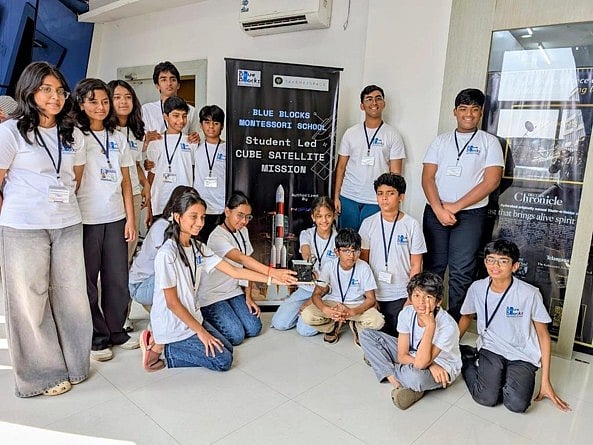
On 12 January 2026, ISRO’s PSLV-C62 lifted off from the Satish Dhawan Space Centre at Sriharikota carrying a set of small payloads alongside its main mission. One of them, a thermal sensor payload called SBB-1, had been designed and built by 17 students aged 12 to 16 from Blue Blocks Montessori School in Hyderabad. Minutes into the flight, the rocket’s third stage suffered an anomaly, and all of the payloads on board were lost.What remains of SBB-1 is not in orbit. It is in a record: an authorisation from India’s space regulator, qualification test results, a published mission document and the students’ own design files. For a school, that record may turn out to be the most valuable thing the project produced.Not a satellite launch: what SBB-1 actually wasSearch results for a student satellite program in India tend to blur an important distinction. SBB-1 was not a standalone satellite. It was a hosted payload: a self-contained instrument that travels on a larger spacecraft, known as the host, which provides power, communication and a ride to orbit.The payload was built to the dimensions of a 1U CubeSat, a cube 10 centimetres on each side, and its instrument was a multi-point thermal sensor array designed to measure temperature at several points in space. The host spacecraft was the MOI-1 bus, operated by the Indian space-technology company TakeMe2Space, which acted as the project’s technical integration partner.The hosted model suits a school project well. Because the host spacecraft supplies power, communication and the ride to orbit, a student team can concentrate on the instrument itself: what it should measure, how it should be built and how to prove it will survive. It also means the students work alongside professional engineers on the parts of a mission that would be beyond a school’s resources, learning how a real space project divides its responsibilities.What is CubeSat and how do students build it?A CubeSat is a standardised small spacecraft format, built from units of 10 by 10 by 10 centimetres. Because the size and interfaces are standard, CubeSats and CubeSat-format payloads can be designed, tested and launched far more affordably than conventional spacecraft, which is why universities, start-ups and, increasingly, schools use them.Building one is less about assembling parts than about meeting requirements. Students define what the instrument should measure, choose components that can survive launch and space, design and assemble the circuit board, and then prove through testing that the hardware will work. At Blue Blocks, the students designed and assembled the payload’s circuit board themselves. The finished hardware then passed a series of qualification tests at approved facilities: thermal vacuum cycling between minus 20 and plus 60 degrees Celsius, random vibration testing to ISRO specifications, and electromagnetic compatibility and structural checks.The paper trail: how the project was documentedEvery stage of SBB-1 left a document behind, and that is the part of the project other schools can learn most from.The authorisation. Any activity in space by a non-government entity in India requires approval from IN-SPACe, the Indian National Space Promotion and Authorization Centre. SBB-1 received authorisation PMA/IN-SPACe/AUTH/2026/115, issued to Blue Blocks Montessori Educational Society for the establishment and operation of the SBB-1 hosted payload. Under it, the Society accepted legal responsibility under the international conventions on liability and registration that govern objects in space.The registrations. The payload was entered in the Department of Space master registry in December 2025, and a radio-frequency filing was made with the International Telecommunication Union through the host operator.The division of roles. The project ran on a three-part structure: the student team handled design, development and testing; Blue Blocks Micro Research Institute provided pedagogical and regulatory guidance; and TakeMe2Space provided the technical architecture, hardware validation and launch integration. Writing that structure down at the start meant that every decision could later be traced to whoever made it.The mission record. After the launch, the project was written up and archived as Valorization in Orbit: An Adolescent CubeSat Mission (January 2026), alongside the authorisation itself, which is published with a permanent identifier. An overview of the project is available on the Blue Blocks SBB-1 project page.”When the rocket failed, the first question from the students was not whether we would try again, but what we had recorded,” says Pavan Goyal, Founder of Blue Blocks. “That told me the project had done its job. A launch lasts a few minutes. A well-kept record lasts long enough for the next team to build on it.”What is the Blue Blocks Space Program?The space programme at Blue Blocks sits within the school’s adolescent years, from Classes 7 to 10, at its Tellapur campus. It treats space not as a topic but as a working environment with real rules: orbital mechanics, power budgets, telemetry, regulatory approval and the responsibility of putting an object into a shared orbit. Students learn the science through the demands of an actual mission rather than a textbook chapter. The wider student space learning programme is run through the school’s space lab.The students who built SBB-1 have not left the project behind. They are now mentoring a younger team working on a second payload, SBB-2, which the school is working towards for 2027. The design files, test results and lessons from SBB-1 are the starting point for that work, which is exactly what a documented project makes possible.”It was a hard morning for the children, and for all of us,” says Munira Hussain Kagalwalla, Co-founder and Director of Blue Blocks. “But within a week they were back in the lab, going through the test data line by line. Watching them turn disappointment into a plan for SBB-2 was one of the proudest moments we have had as a school.”The benefits of space programs in schoolsThe case for a school with a space program in India is sometimes made in terms of inspiration alone. SBB-1 suggests the benefits are more concrete, and most of them do not depend on the launch succeeding.Working to a real standard. A payload that must pass vibration and thermal vacuum tests cannot be “nearly right”. Students learn what a specification is, and why it matters, in a way no classroom exercise can replicate.Seeing a whole system. A thermal sensor is useless without power, data handling and a host spacecraft to carry it. Students learn that every part depends on every other, and that a design decision in one place has consequences somewhere else.Understanding responsibility. Few school projects involve a government authorisation and international treaty obligations. Learning that space is regulated, shared and governed by law gives students a very different sense of what engineering involves.Learning to document. Perhaps the most transferable skill of all. Engineers, scientists and researchers spend a large part of their working lives recording what they did and why. SBB-1’s students learnt that habit under real conditions, with real consequences.How the research institute supports projects like thisProjects on this scale need more than enthusiasm. At Blue Blocks, the Blue Blocks micro research institute provides the framework that turns student work into a usable record: guidance on regulatory processes, standards for how observations and data are kept, and a route to publishing outcomes with permanent identifiers so that others can find and cite them. For SBB-1, the institute’s role was to make sure that whatever happened on launch day, the knowledge the students built would not be lost with the hardware.A school with a space lab in HyderabadThe space lab is based at the school’s Tellapur campus, where it sits alongside drone, biomimicry and innovation labs as part of a wider innovation curriculum. For families looking for a school with an innovation curriculum in Hyderabad, the distinctive feature is that these labs are not separate from the rest of the school day. They are where the adolescent years’ academic work is put to use on problems with real stakes.Lessons for any school attempting thisFor schools and educators considering a student space project of their own, SBB-1 offers three practical lessons.Start the paperwork on the first day. Regulatory approval, registration and frequency filing take time, and the documents produced along the way are part of the learning, not a distraction from it.Define roles in writing. A clear division between students, mentors and the technical partner protects the integrity of the students’ work and makes every decision traceable later.Plan for the outcome you cannot control. Launch failures happen to national space agencies, not only to schools. A project designed to leave behind a complete record still has value when the rocket does not reach orbit, and gives the next team somewhere to begin.The students who built SBB-1 learnt that lesson in the hardest way possible. In 2027, the team working on SBB-2 will begin with everything they recorded.Frequently Asked QuestionsWhat is the difference between a student satellite and a hosted payload? A standalone satellite requires its own power, propulsion, and communication systems. A hosted payload (like SBB-1) is a self-contained instrument that hitches a ride on a larger professional spacecraft. This allows students to focus entirely on designing the instrument and analyzing data, rather than building the entire spacecraft infrastructure.How do students test a space payload before launch? Before IN-SPACe grants authorization, the hardware must survive rigorous qualification testing at approved facilities. Students must prove their payload can withstand extreme thermal vacuum cycling (from -20°C to +60°C), intense launch vibrations, and electromagnetic compatibility checks to ensure it won’t interfere with the host spacecraft.Why is documentation so important for a student space mission? A rocket launch can fail in minutes, but proper documentation ensures the educational value survives. By archiving design files, qualification test results, and regulatory authorizations with permanent identifiers, students learn how professional engineers record their work, and future teams have a blueprint for their own missions.What happens if the rocket carrying a student payload fails? Launch anomalies are a reality of space exploration. When the PSLV-C62 mission was lost, the Blue Blocks students used their archived data and test results to immediately begin designing a successor payload, SBB-2. The failure provided a masterclass in engineering resilience and the critical importance of a well-kept mission record.
Source: Deccan Herald
🔑 Key Takeaways
- Wire dispatch directly ingested from deccanherald.
- Published at Wed, 25 Nov 2026 12:11.
- Source URL: https://www.deccanherald.com/connect/documenting-a-student-space-payload-project-lessons-from-blue-blocks-4230873