
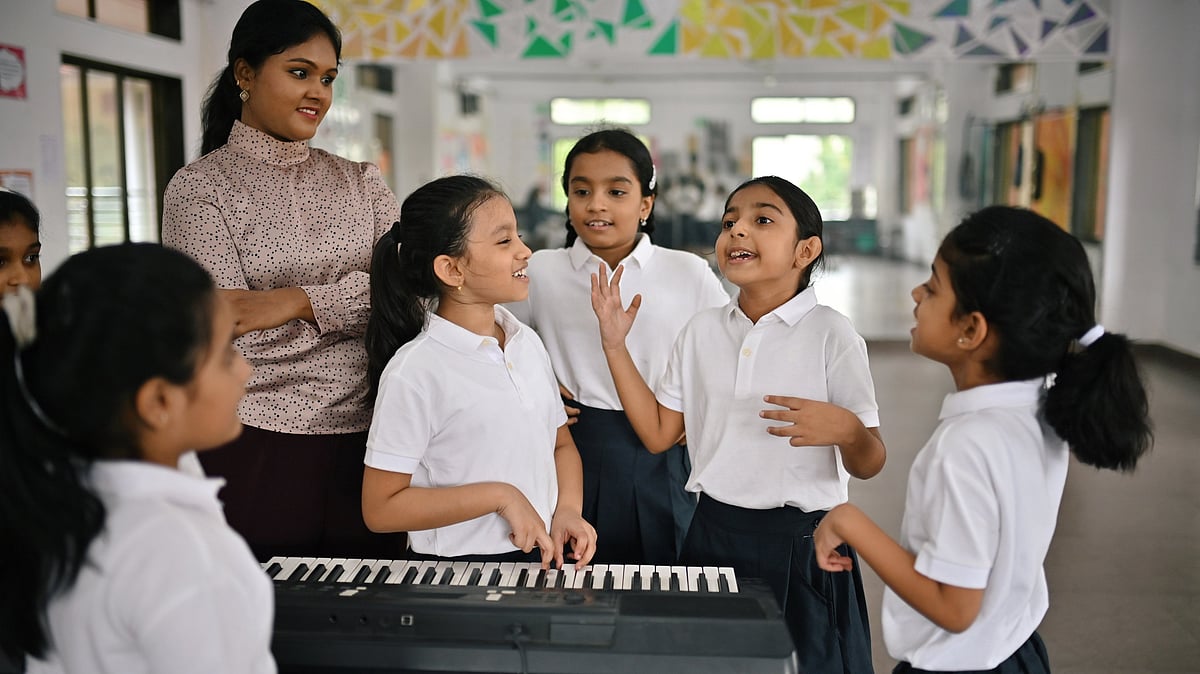
Identifying talents
at the core of education
A glance at the etymology of the word education is, in a way, an eye-opener. It is derived from three Latin words: ‘educare’ — meaning to bring up, rear, nourish, or train; ‘educere’ — meaning to lead out, draw out, or bring forth; and ‘educatum’ — meaning the act of teaching or training.Among these, ‘educere’ is particularly significant in modern educational philosophy. It suggests that education is not merely a process of “filling” minds, but one of “drawing out” what already exists within the learner. In fact, ‘educare’ and ‘educere’ together can fulfil education’s ultimate goal. This etymology supports the idea that education’s primary aim is to help individuals discover and develop their unique strengths rather than simply accumulate information.AI education in schools: Karnataka plans to rope in GoogleFirst, one must identify what needs nourishing before deciding how to nourish it. Our schools, therefore, play a vital role in identifying the innate talents, potential, and abilities already present in learners, because childhood and early adolescence are the most crucial stages for this process to begin.This should not remain merely a philosophical concept; it must become a practical guideline for the teaching-learning process. Even our teacher education programmes need to be overhauled to align with the needs of the time and fulfil the educational imperative of discovering and developing learners’ innate capacities.Unfortunately, despite all our talk about the holistic development of the individual through education, we often mistake it for filling young minds with information on a wide variety of subjects. This misconception is reflected in the number of subjects and textbooks that fill a primary school child’s satchel.Going beyond marksEducation is often measured by marks, grades, and examination results. While these parameters matter, we often fail to realise they are not ends in themselves; they are only indicators. A destination board is not the destination itself — it merely points the way. Similarly, examination scores can indicate progress, but they do not define a learner’s full potential.Higher-order questioning: The secret behind classrooms that create problem solvers, not note takersI remember one of my students who never secured impressive grades in any academic subject. As a result, teachers and parents alike often criticised him. At every open house, no teacher had a good word for him. They even overlooked the fact that he was exceptionally well-behaved. Of course, their intentions were good: they wanted him to “improve”. But improve what? That is the real question.His physical education teacher, however, identified his talent and nurtured it by encouraging him to participate in various inter-school competitions. For this, the teacher was heavily criticised for “spoiling” the boy’s future by distracting him from his supposedly all-important, future-deciding board examination. He even had to argue with the school administration to secure permission for the boy to participate in these events.The student eventually passed the board examination with just over 50 per cent marks. But by then, the Sports Authority of India (SAI) had already selected him, and there was no turning back. To cut a long story short, today he is a Professor of Physical Education at a university. He travels widely, delivering motivational speeches in schools and colleges. His story is a powerful reminder that education achieves its true purpose when it helps learners discover and develop the talents that lie within them.Our society needs a change in perspective. A truly educated society is not one where everyone gets 90%. Rather, it is one where the writer writes, the actor acts, the builder builds, the healer heals, and the teacher teaches — each having found their calling early.Embedded internships in Global Capacity Centres can build work-ready talentIf we place talent identification at the heart of education, we stop producing job-seekers and start nurturing creators, leaders, and innovators. The question we must ask in every classroom should not be, "How intelligent is this child?" but rather, "How is this child intelligent?"(The author is an English lecturer at a Shivamogga-based school)
Source: Deccan Herald
🔑 Key Takeaways
- Wire dispatch directly ingested from deccanherald.
- Published at Tue, 06 Oct 2026 04:49.
- Source URL: https://www.deccanherald.com/education/identifying-talents-at-the-core-of-education-4171557