
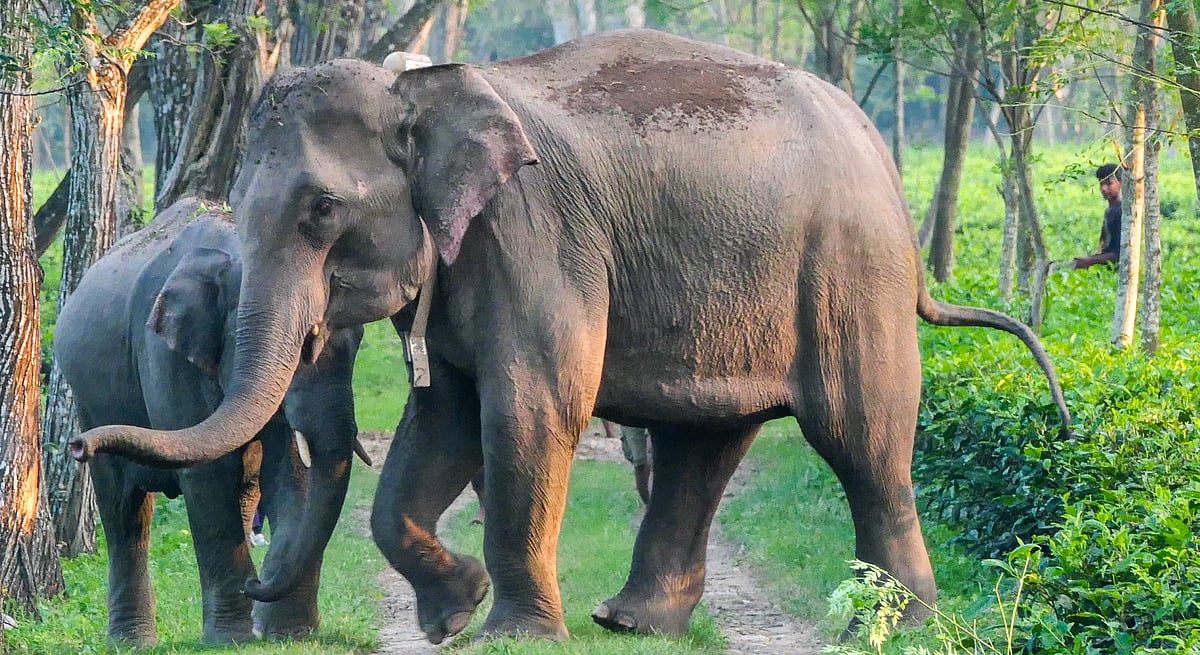
Guwahati: Movement of wild elephants near agricultural fields, tea plantations and human settlements increases during post-Monsoon cropping season–the time that witnesses maximum human-elephant conflict, a first ever fi…
Guwahati: Movement of wild elephants near agricultural fields, tea plantations and human settlements increases during post-Monsoon cropping season–the time that witnesses maximum human-elephant conflict, a first ever five-year GPS tracking of at least four herds of wild elephants in three districts in Assam revealed.Four female jumbo-led herds and a solitary male elephant were radio collared with GPS in Udalguri, Sonitpur and Biswanath, three worst human-elephant conflict-affected districts, and their movement were tracked between 2021 and 2026. The study generated more than 38,000 GPS locations, providing high-resolution data on seasonal elephant movements across multi-use landscapes. Supreme Court order on obstructions along elephant corridors triggers major political row in Kerala The GPS tracking revealed that several movement routes intersect roads, railway lines, and settlements, highlighting the need to implement mitigation measures and safeguards to reduce risks to human lives and prevent elephant casualties. The study also recorded transboundary elephant movement between Udalguri in Assam and adjoining Jomotsangkha Wildlife Sanctuary in Bhutan during dry season, calling for greater transboundary coordination between the two countries to conserve elephant and wildlife corridors.The study was carried out by the state forest department with the help of World Wide Fund for Nature-India (WWF-India).”The Sonai Rupai Wildlife Sanctuary, Behali Wildlife Sanctuary and Bornadi Wildlife Sanctuary have emerged as important habitats extensively used by the collared elephants. At the same time, tea plantations served as significant movement pathways and secondary habitats, often bringing elephants into close proximity to people. The elephants were also observed using river channels to move north–south between the forests of the Himalayan foothills and the Brahmaputra grasslands (riverine sandars or chaporis), providing important insight into their pathways through these areas,” stated the report titled ‘Tracking the Giants: Movement and Habitat-Use Patterns of GPS-Collared Elephants in Assam’. The report was formally released by Assam forest minister Jayanta Mallabaruah on the occasion of the 72nd Wildlife Week event held in Guwahati on Tuesday (October 6).In Sonitpur, two female jumbos, named Tara and Phul, were radio collared with GPS trackers, two in Udalguri, Budhini and Mynow and a solitary male, Bishnu in Biswanath district. “This report fills a major knowledge gap in terms of elephant presence and movement in the state. The findings provide important baseline information on elephant-ranging patterns, particularly where they overlap with human land use. This information will help in formulation of conservation strategies and strengthen human-elephant coexistence measures,” said Vinay Gupta, Principal Chief Conservator of Forests-Wildlife and Chief Wildlife Warden, Environment, Forest and Climate Change Department, Assam. Aritra Kshettry, WWF-India’s Lead for the Elephant Conservation Programme said, “The GPS telemetry survey has helped identify core natural and secondary habitats used by the collared elephants and revealed a strong seasonal pattern in their movements. The findings of this report provide an important evidence base for securing elephant habitats and movement routes in Assam while at the same time informing proactive management of human-elephant conflicts”.Jumbo challengeLoss of elephant habitats have led to rise in human-elephant conflict in Assam, a state having 5,828 Asian elephants, the second highest jumbo population after Karnataka. With large-scale deforestation in the early 1900s, when forests were cleared for tea plantations, and more recent forest loss to make room for agriculture and human settlements, elephants have adapted to human-use landscapes dominated by tea plantations and other agricultural land. “As elephants increasingly use these human-dominated landscapes, crops such as paddy, maize, banana, sugarcane, and areca-nut have been incorporated into their diets, both for solitary males and female-led herds. As elephants move between fragmented and depleted forests, their ranges increasingly overlap with human settlements and farms, often resulting in crop and property damage, human casualties, and injury or mortality among elephants,” said the report.Between 2000 and 2023, Assam reported 1,468 human deaths and injury to another 337, while 626 elephants also died due to human-induced reasons such as electrocution, poisoning and railway collisions.
Source: Deccan Herald
🔑 Key Takeaways
- Wire dispatch directly ingested from deccanherald.
- Published at Tue, 06 Oct 2026 16:10.
- Source URL: https://www.deccanherald.com/india/assam/elephant-movement-in-human-settlements-increases-during-post-monsoon-finds-gps-tracking-study-4172764