
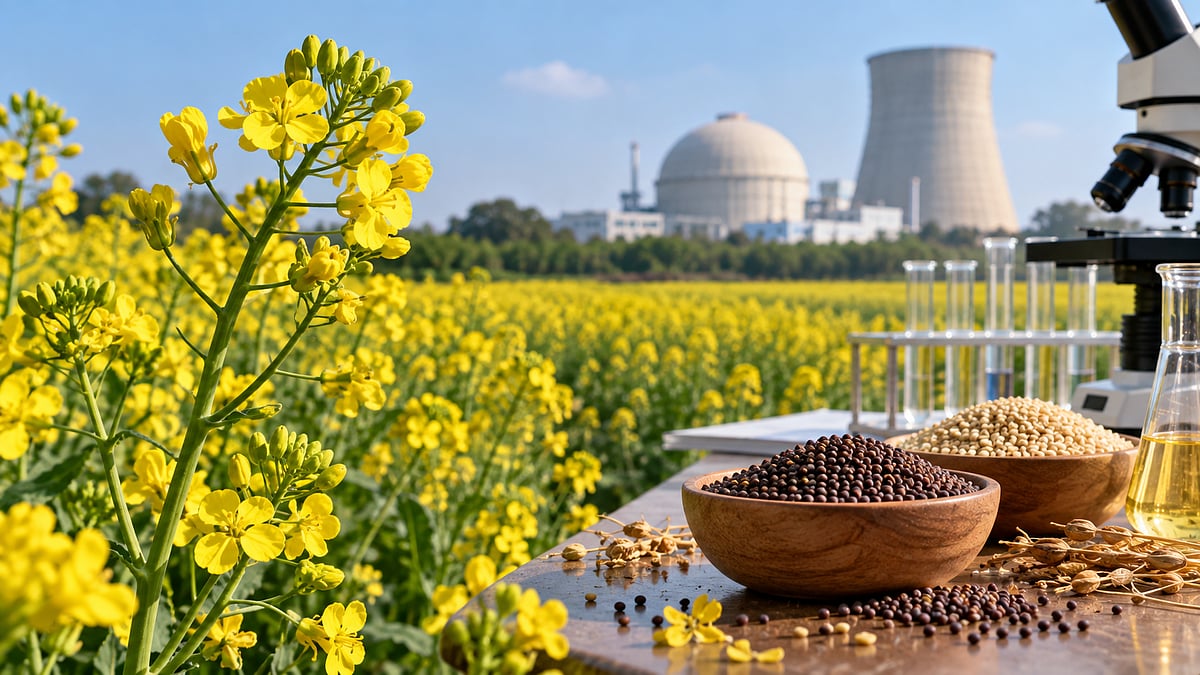
UAS-Dharwad explores nuclear technology for better crops
Dharwad: The University of Agricultural Sciences (UAS), Dharwad, has, for the first time in the state, used nuclear technology to develop improved crop varieties through radiation-induced mutation breeding. The method developed by Bhabha Atomic Research Centre (BARC), a unit of the Department of Atomic Energy (DAE), has been used to improve mustard and sesame crops. According to the university, the initial experiments have resulted in a yield increase of about 35% in mustard and 15% in sesame.The scientists now plan to extend the technology to 25 other crops, including maize, soybean, groundnut, wheat, cardamom and green gram. As per researchers, the project focuses on application of an established technology in a new set of experiments at UAS-Dharwad, with controlled radiation used to induce desirable genetic changes in crop seeds. Greenery on farmland eludes Dharwad, Kalghatagi from getting drought tagThe pilot project was taken up following a Memorandum of Understanding (MoU) signed between UAS-Dharwad and BARC in 2025. While Bhuvaneshwaragouda R Patil led the experiments on mustard, Anisa Nimbal led the work on sesame.“The seeds were treated with controlled radiation to induce useful genetic variations. The objective was not only to increase yield but also to develop desirable traits that could help crops withstand diseases and other stresses,” Patil said.He said the treated seeds have so far shown encouraging results, with the crops recording higher yields and no significant disease incidence during the trials. The broader objective is to modify nutritional characteristics, including vitamin content, while developing high-yielding varieties that can benefit farmers.He added that the oil content in mustard had increased by 40% after getting the first yield in the last week of August. According to the scientists, controlled exposure of seeds to electron beams or gamma rays can reduce harmful microorganisms, control mold and extend shelf life of the seeds and the produce. “Treated mustard and sesame do not become radioactive and the produce irradiation is recognised as safe by international organisations, including the World Health Organization (WHO) and the International Atomic Energy Agency (IAEA),” Patil said.According to the DAE, the treated mustard and sesame are safe for consumption. UAS Vice-Chancellor Prakash N B said the use of nuclear technology in agriculture had become increasingly relevant in the face of climate change, global warming, irregular rainfall and pest attacks. “Agriculture is facing several challenges due to changing climatic conditions, water stress and increasing pest attacks. Radiation-induced mutation breeding can help scientists develop crop varieties with improved characteristics and greater resilience,” he said.
Source: Deccan Herald
🔑 Key Takeaways
- Wire dispatch directly ingested from deccanherald.
- Published at Sat, 19 Sep 2026 20:18.
- Source URL: https://www.deccanherald.com/india/karnataka/how-nuclear-science-is-helping-dharwad-grow-crops-with-35-higher-yields-4152427