
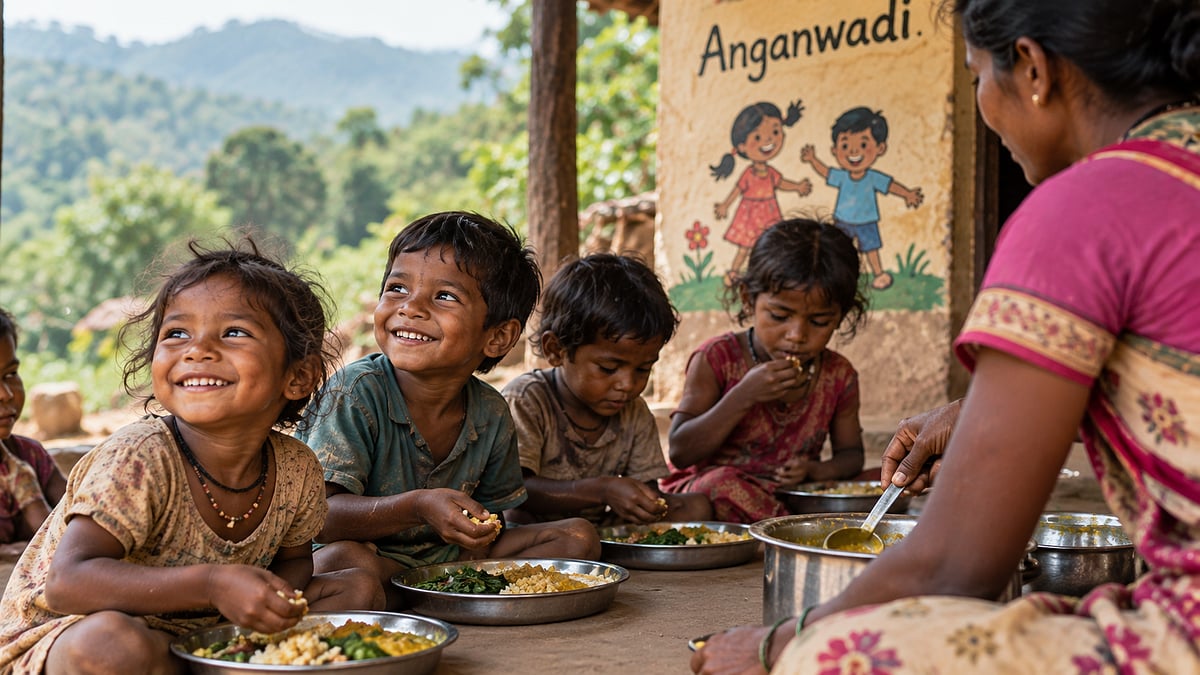
In anganwadis, tribal children need food they can call their own
A Kadu Kuruba child in a forest village asked a simple question: ‘Why don’t we get the food we eat in our haadi?’ A mother raised a similar concern: if her child happily eats certain foods at home, why cannot those foods be served at the anganwadi?The questions point to something often missing from conversations about child nutrition: food is not only about calories and nutrients. It is also about familiarity, taste, culture, and a child’s relationship with land and food sources developed over generations. Recognising this is a matter of dignity, equity, and rights.This matters especially for children living in forest and hilly tribal communities, whose food traditions have evolved around their local ecology. Their diets may include millets, pulses, tubers, leafy greens, vegetables, fruits, seeds and, in some communities, fish or other locally sourced animal foods. Yet these familiar foods are not always reflected in meals served through anganwadis, ashram schools and hostels.September marks Rashtriya POSHAN Maah, focusing on nutrition, dietary diversity, and community participation through Anganwadis. The ninth POSHAN Maah began on September 9 and emphasises fresh, hot-cooked meals and community participation.The message is simple: our anganwadi, our responsibility. But if an anganwadi is truly ours, whose food should children find on their plates?Interactions with the Jenu Kuruba, Kadu Kuruba, Hasalaru, Gowdalu, and Siddi communities in Karnataka’s Western Ghats bring this question into focus. Each has its own food identity. Jenu Kuruba traditions include forest foods and honey; Kadu Kuruba’s include tender bamboo shoots and bamboo seeds; Hasalaru has locally available forest resources; and Gowdalu communities draw on pulses and vegetables cultivated around their settlements and coffee estates. Siddi communities, too, have distinct food traditions.The point is not to romanticise these food systems or suggest that every tribal community eats the same foods. There is no single “tribal diet”. The important principle is that food is rooted in place.Displacement, restrictions on forest access, changing livelihoods, and dependence on purchased and subsidised foods can reduce dietary diversity. In remote and hilly areas, difficult terrain can also make delivery of supplementary nutrition challenging, particularly during the monsoon.But physical access is only part of the problem. Food that is unfamiliar or does not fit local practices may remain uneaten, and uneaten food cannot nourish a child.The National Family Health Survey (NFHS)-6, 2023–2024, shows national progress, with stunting, wasting and underweight among children under five declining. Yet national averages can conceal vulnerabilities in remote and marginalised communities. Studies among tribal children in Karnataka and elsewhere continue to document under-nutrition and inadequate dietary diversity.The answer is to make nutrition programmes work with local food knowledge. The National Food Security Act, 2013, provides nutritional entitlements for children, while recognising the need to reach remote communities.Section 3(1)(c) of the Forest Rights Act, 2006, recognises communities’ right to gather minor forest produce, including fruits, seeds, honey and tubers, for children’s consumption.Mission Poshan 2.0 and PM POSHAN provide scope for locally appropriate menus, reflecting local tastes and agro-climatic conditions. The Ministry of Education and NITI Aayog have also encouraged millets in school menus, particularly in hilly and tribal districts.CJP leader Abhijeet Dipke tears up copy of MoU between Maharashtra govt, trust over tribal hostelsThe UN Convention on the Rights of the Child recognises children’s rights to survival, development and adequate nutrition. The UN Declaration on the Rights of Indigenous Peoples recognises indigenous peoples’ rights to maintain cultural practices connected with health, food, lands and resources.Together, these frameworks support a principle that children’s nutritional rights should respect the cultural and ecological contexts in which food is produced, prepared and eaten.Anganwadis serving forest and hilly tribal communities could undertake a community food-mapping exercise. Mothers, elders, anganwadi workers, cooks, health workers, and community groups could identify nutritious local foods, seasonal availability, and suitable preparations. Children too can be asked what they enjoy. These discussions could inform local menus while meeting nutritional and food-safety standards.Poshan Vatikas can become more meaningful when they grow foods that children recognise and eat. The same principle should extend to schools and hostels.Animal-source foods require similar sensitivity. Some forest-dependent communities traditionally consume fish, crabs or other locally available foods; others may not. They should neither be prescribed nor excluded uniformly.Making this approach real requires resources as well as policy. Local procurement must be adequately funded. Tribal farmers, women’s groups and local producers can be supported as suppliers. Most importantly, communities must have a genuine role in deciding what is served.Treating children equally does not mean feeding every child the same food.Poshan Maah can encourage us to look beyond standardised menus and listen to children and communities about the food they know, value, and enjoy.Instead of asking only, ‘What food can we give these children?’, perhaps we should ask, ‘What nutritious food do forest and hilly tribal children and their communities value, eat and want – and how can the State support access to it?’If ‘Our Anganwadi, Our Responsibility’ is to become more than a slogan, the answer must begin with listening to the children and communities whose anganwadis we ask them to call their own.(The writer works at the Centre for Child and the Law, National Law School of India University, Bengaluru) (Disclaimer: The views expressed above are the author’s own. They do not necessarily reflect the views of DH.)
Source: Deccan Herald
🔑 Key Takeaways
- Wire dispatch directly ingested from deccanherald.
- Published at Sun, 20 Sep 2026 21:48.
- Source URL: https://www.deccanherald.com/opinion/in-anganwadis-tribal-children-need-food-they-can-call-their-own-4153179