
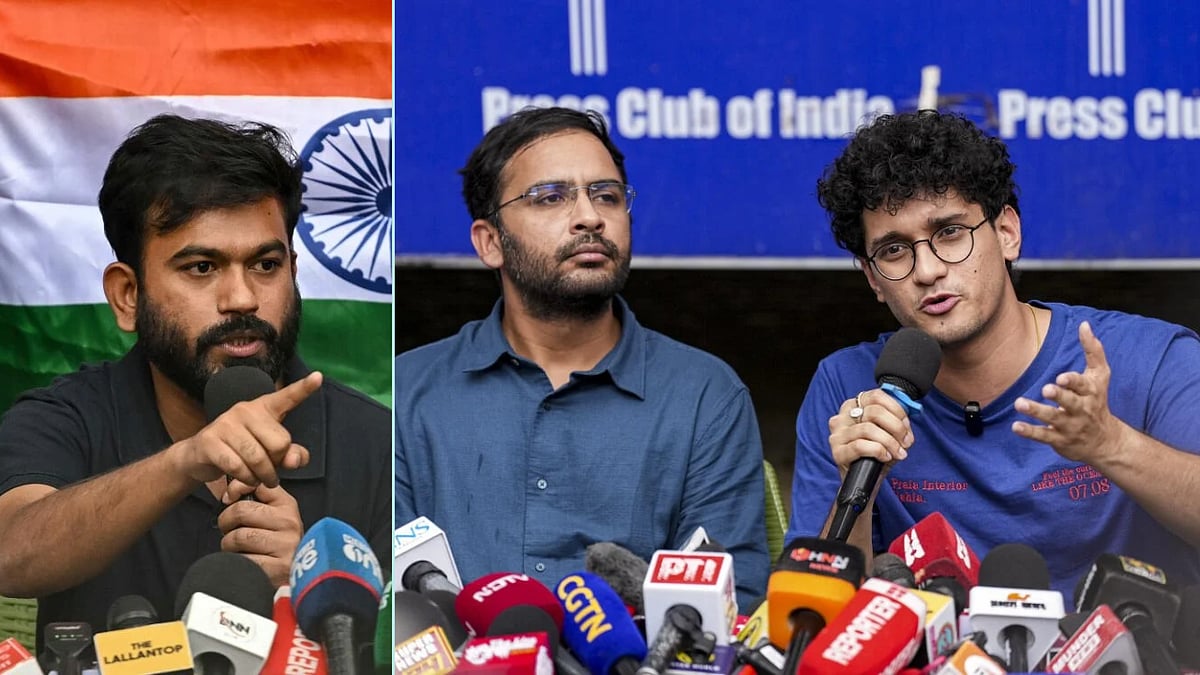
New Delhi: To rebut a report by a United Nations special rapporteur, New Delhi has cited the Cockroach Janata Party’s (CJP) protests as evidence of freedom of expression in India. This comes even as the party’s found…
New Delhi: To rebut a report by a United Nations special rapporteur, New Delhi has cited the Cockroach Janata Party’s (CJP) protests as evidence of freedom of expression in India. This comes even as the party’s founder, Abhijeet Dipke, has undergone another detention lasting around 24 hours, while its other leaders, Saurav Das and Ashutosh Ranka, have remained in Tihar Jail since Wednesday.India told the United Nations that it had engaged constructively with young people and students who protested in June and July this year against question paper leaks in the National Eligibility cum Entrance Test (NEET) and other examinations.“Within weeks, Parliament amended the Public Examinations Act, doubling punishments for paper leaks, carried out systemic Examination Overhaul and created fast-track courts in every State, specifically dedicated to prosecuting individuals involved in exam fraud,” Anuj Swarup, the first secretary of India’s permanent mission to the UN in New York, told the international organisation. “This is the true testament of democracy in action.”The protesters had to fast for weeks and march on the streets of New Delhi, facing a police crackdown before the government accepted their demand for the resignation of Dharmendra Pradhan as Education Minister.New Delhi questioned the veracity of the report submitted to the international organisation by its Special Rapporteur on Freedom of Peaceful Assembly and Association, Gina Romero, particularly its references to India.Romero noted in her report that “young people from India” had reported “retaliation or stigmatisation for discussing mental health or gender justice”.Her report examined the changing nature of youth-led movements worldwide, highlighting how young people increasingly organise through informal, decentralised networks rather than traditional institutions. It noted that they use digital platforms and spontaneous collective action to mobilise around shared concerns, challenge authority and demand democratic participation. The report cited examples from Serbia, Nepal and India to illustrate this evolving pattern of political engagement.Apparently referring to the CJP, Romero also took note of “a satirical political movement” launched by young people in India.“In India, young people created a satirical political movement,” she noted, before concluding that the horizontal, spontaneous structure of such movements enabled rapid mobilisation in response to political crises through immediate “response hashtags”. Informal organising, she said, allowed young people to act quickly, reduce risks and involve participants who might otherwise avoid activism.New Delhi noted that the freedoms of peaceful assembly and association, along with freedom of speech and expression, were guaranteed to every Indian citizen under Article 19 of the Constitution. Delhi protest against CEC: UN raises concerns over mass detentions These freedoms, it said, were protected by an independent judiciary, a free press and an empowered National Human Rights Commission.Swarup articulated New Delhi’s response to the report, criticising Romero’s assertion that young people in India faced “retaliation or stigmatisation for discussing mental health or gender justice”. He noted that the UN Special Rapporteur on Freedom of Peaceful Assembly and Association had made the assertion by citing unnamed “submissions” in a footnote.“This level of arbitrary report writing is precisely the reason that the United Nations and its institutions have lost credibility,” Swarup said, adding, “A sweeping charge against the world’s largest youth population, resting on anonymous and unverifiable claims, is not evidence. It is hearsay dressed up as a UN report, and my delegation rejects it outright.”He then referred to the “satirical political movement” in India to dismiss the UN report itself.“Ironically, the same report notes that young Indians created a satirical political movement. In which repressive State does a satirical youth party question the Government, march on the capital, and then sit across the table with senior national leaders?” he said.New Delhi cited the CJP’s protests over NEET question paper leaks at the UN as evidence of freedom of peaceful assembly in India. This came as activists from the political movement launched by Dipke again took to the streets, demanding the resignation of Chief Election Commissioner Gyanesh Kumar over alleged irregularities in the Special Intensive Revision (SIR) of electoral rolls.The campaign against the Chief Election Commissioner was followed by a series of detentions of CJP leaders and activists. Dipke and CJP co-convenors Saurav Das and Ashutosh Ranka were detained shortly after disembarking from a plane at Delhi airport on October 10, as they arrived to lead a protest demanding Kumar’s resignation.While Dipke was released after around 24 hours, Das and Ranka were arrested on October 14 following their detention during a protest at Jantar Mantar on October 13 and were remanded to judicial custody.Dipke was detained again on October 16 ahead of a planned march in Connaught Place, New Delhi, in which protesters intended to wave the national flag. Neha Bora, president of the All India Students’ Association (AISA), was also detained.
Source: Deccan Herald
🔑 Key Takeaways
- Wire dispatch directly ingested from deccanherald.
- Published at Sat, 17 Oct 2026 16:37.
- Source URL: https://www.deccanherald.com/india/india-cites-cjp-as-proof-of-democracy-at-un-even-as-its-leaders-face-arrests-at-home-4186643