
People do many things for the first time, be it sitting in an airplane or attending a college. When they cannot contain the excitement, they transmute some of it onto social media, in the form of pictures or videos.Somet…
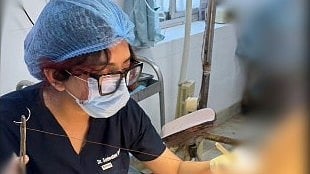
People do many things for the first time, be it sitting in an airplane or attending a college. When they cannot contain the excitement, they transmute some of it onto social media, in the form of pictures or videos.Sometimes this tendency can stem from a desire to share happiness, other times it can be to seek validation in quantifiable form – likes and views.A medical intern from Kolkata got herself into trouble after she shared a snapshot of suturing a woman who had given birth, inside a delivery room.While the patient’s face was kept hidden, the photograph captured her in a vulnerable position on the surgical bed.The picture sparked a conversation online as to what medical doctors can post online and where it must stop.“These days social media is all about flaunting your skills, lifestyle or even a reputable job. Doctors also fall into the same validation-seeking trap. But here’s the catch — some of them may just forget where to toe a line,” said Dr Sarath Narayan, a consultant emergency physician at Baby Memorial Hospital, Kannur, Kerala.How is this ethical and ok for a doctor to to post this? Can you imagine if a male doctor did this? https://t.co/iiKInNVbyy pic.twitter.com/eP8BNUhnN2— Star Girl (@StarGirlonFire7) September 30, 2026
Thane doctor assault | ‘They serve people, cannot be attacked in this manner’: Supreme Court cancels Shiv Sena leader’s bailThe controversyDr Sudeshna, an intern at the Calcutta National Medical College and Hospital (CNMCH) in a habitual update of the day posted a photograph early this month which snowballed into a serious conversation on medical ethics.In the picture she posted on her X handle, she can be seen working inside a delivery room.Draped in her uniform, she can be seen wearing surgical gloves, a mask and a hairnet, holding a needle holder and suture thread in her hands.Lying opposite to her on the surgical bed is a patient, with the upper half of her body chopped off the picture frame.The patient is seen resting in a vulnerable position after childbirth, either waiting or already having to undergo a suture in her pelvic region.Having dropped the picture with a caption in Hindi, saying “Silai bunai aata hai kya” (do you know how to sew?), the post got filled with remarks objecting to the act.“A female doctor is allegedly photographing unconscious patients without consent and turning their most vulnerable moments into social media content. Blurred online. Unblurred on her phone. Zero consent. This is not medicine. This is a serious violation of patient dignity, NMC ethics, and privacy laws,” said Mayank Burmee, a user on X.Another medical doctor Dr BL Bairwa also disapproved of the act and said: “Unethical, dear unethical.”Some users made it a gendered problem. One said that if a male gynaecologist had done the same, it would have cost him his licence.Code of conductSpeaking to DH, Dr Sarath Narayan said: “Sometimes, intent of posting a clinical photograph also counts. Was it posted for educating others or explaining a procedure to the audience, or sharing a bit of one’s day or simply to get some attention. Apart from the de-identification protocol, the reason behind posting it gives all the answers.”According to the Code of Medical Ethics Regulation (2002) as laid down by the National Medical Commission (NMC), a registered medical practitioner is prohibited to publish photographs or case reports of his or her patients without their permission.While the doctor has reassured that the patient consented to her taking a picture, there are considerable reasons for why the photograph may be perceived unethical.The section 7.17 of the code of conduct prohibits a medical doctor from sharing any picture or information about the patient which can reveal their identity.As per studies, de-identification of a patient’s photograph is not limited to cropping out their face.There are other physical biomarkers like body shape, scars, moles, background of the picture, clothing and even the time around which the photograph was captured. Seeking permission from the patient also involves informing them about the potential use of the images.Picture not taken for educational purposesThe NMC permits healthcare professionals to disseminate medical advice on public health issues. This has extended to social media where many medical doctors have assumed roles of medical influencers, educating people on varied aspects of healthcare.With this stipulation, many doctors and surgeons may use de-identified clinical photographs for educational purposes like publishing them in peer-reviewed journals or presenting them at a seminar or conference or inside a medical school.Booming fields like cosmetology and dermatology, which are highly based on external results, may also use these pictures for a comparative analysis, showcasing ‘before’ and ‘after’ effects of a certain treatment.However, even for these branches, NMC asks them to avoid sharing information that may bend towards self advertisement and marketing.Phones hold secretsReportedly, many healthcare professionals have been guilty at some point of having clinical photographs of their patients in some remote corner of their smartphone’s gallery.With smartphones, taking medical pictures has been very easy for both doctors and patients alike.A patient having a toothache won’t hesitate taking a random snapshot of their oral cavity and shooting it straight to their dentist.Likewise, a medical student may capture pre-operative or post-operative images fresh from operation theatre to compare results or analyze them for later, using their handy smartphone.Some medical students may also take pictures to keep them as special memories, citing ‘first surgery’ or ‘the most complicated case of my career’ and many other reasons.However, what they do with those pictures directly affects patient safety and privacy.Some studies have shown that a considerable number of medical doctors store clinical photographs directly on their smartphone, with 10 per cent of them not having any password protection or screen lock, risking picture leak and misuse.Consent is complicatedThe AMA Journal of Ethics, as laid by the American Medical Association listed a case study which involved posting of clinical photographs and taking patient’s consent.Dr Mayer, a plastic surgeon, has over 10,000 followers on social media. A patient turns to her for breast reduction. While removing the excessive tissue, the doctor asked the patient if they could take pictures to which the patient agreed.Two weeks later in a post-operative visit, she goes back to the doctor all upset and cranky, saying “I couldn’t believe that you posted that video of my surgery on Snapchat. You hold up my breast tissue for the world to see and call that education?” The doctor was left all confused.Many such lawsuits have been filed in cases where consent was not clear or violated.Concerns raised by people on the Kolkata case were precisely seeking answers if the woman on the delivery table had enough information to give a consent.Though the young intern has argued that pictures were taken hours after the delivery and with consent, the intent to post it on social media has not been made clear.What is analogue paneer? FSSAI ban proposal and health risks explainedNot the first timeThis is not the first time Dr Sudeshna got into a controversy. Months ago, she posted a photograph of a newborn and was received with criticism.Following this post, the young doctor had written an apology saying she was sorry for hurting sentiments.Some followers went ahead in saying, “OT is not a content studio and unconscious patients are not free material.”Trap of validationJust like many other youngsters, Dr Sudeshna may just be an enthusiastic student sharing regular updates from how her day looks like.While filming and social media presence has become an integral part of how Indian youth choose to live, it is important to not put other people’s safety or privacy at risk.
Source: Deccan Herald
🔑 Key Takeaways
- Wire dispatch directly ingested from deccanherald.
- Published at Fri, 02 Oct 2026 11:04.
- Source URL: https://www.deccanherald.com/health/is-it-right-for-doctors-to-post-patient-photographs-on-social-media-kolkata-case-raises-concerns-4168018