
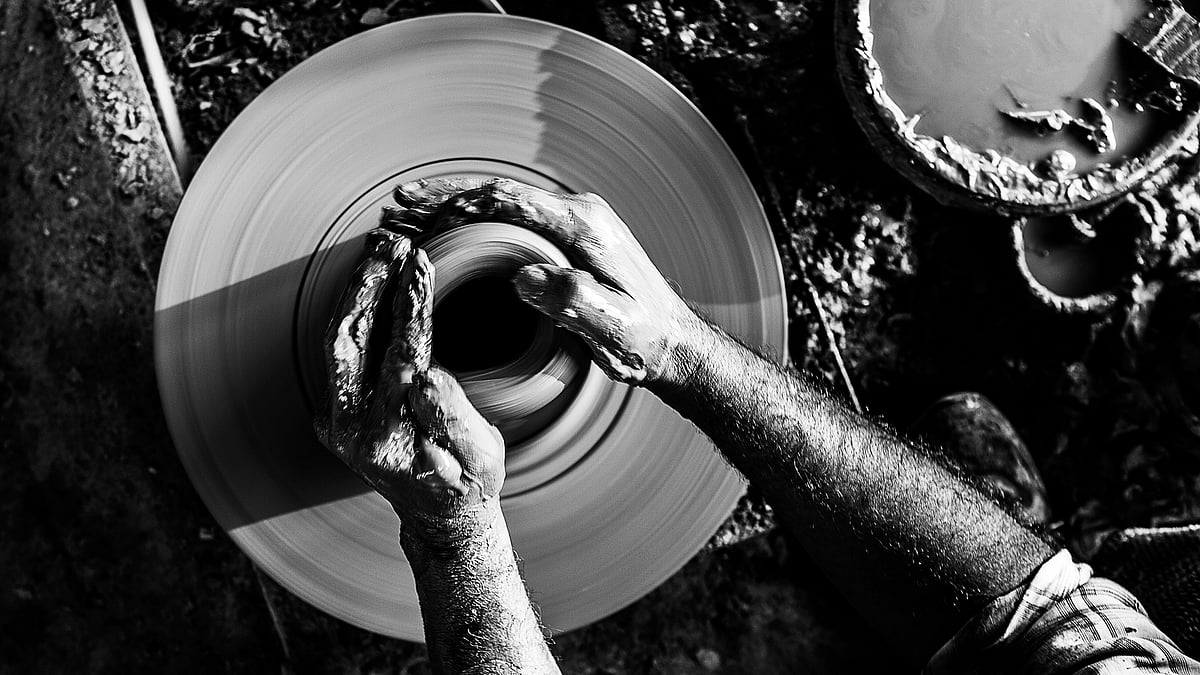
Mind in your hands
In a Callipottery studio in Muneshwara Nagar, Bengaluru, on a recent morning, a group of strangers sit around the clay, learning to coax it into shape — pinching, turning and smoothing it between their fingers, letting a simple lump slowly become something of their own.In Hyderabad, a group of coders filed into a small painting studio one evening, picked up brushes they hadn’t touched since childhood, and spent two hours making no decisions that mattered. No emails, no notifications, no verdicts on whether the work was any good. By the time they left, several had exchanged phone numbers.Pradip, who founded Callipottery, has a theory for why this keeps happening. “People assume it will be easy — that’s how it looks in reels,” he says. “When they try it for the first time, they realise it isn’t, and that goes straight to the ego. They strive to make it possible.” That struggle, he’s found, is the whole mechanism. People get so engrossed trying to centre the clay that they sideline their worries without meaning to, and over weeks, that sidelining becomes a pattern. “For a few hours you can just focus on this one thing,” he says. “In the long run, it helps bring back focus. And the sense of accomplishment brings down anxiety and stress.”A wobbling pot or a clumsy brushstroke asks nothing of you except presence, which is exactly what depletion strips away. That’s why so many exhausted people are finding repair not in another wellness tip, but in the joy of working with their hands.Disrupting perfectionTake Apurva Chavan, who runs Tara Clay Works out of a home studio in Bengaluru and has spent five years at the wheel. She came to pottery in April 2022, looking for a creative space that didn’t insist on one correct way of doing anything, and what began as curiosity, in her words, “quickly turned into an obsession.” What clay actually gave her, though, had less to do with the pots and more to do with everything she’d spent years trying to control. “We spend most of our lives being conditioned to pursue perfection,” she says. “Clay disrupted all of that for me.” The material, she’s found, is patient in a way people rarely are with themselves — it cannot be rushed, and it quietly dismantles your ego every time you try to force an outcome.For Chavan, the lesson went beyond the studio. She grew up, like many, aggressively tidying her surroundings because “log kya kahenge” — what will people say — had lodged itself somewhere permanent. Clay, being clay, refused to cooperate with that instinct. “It won’t be perfectly clean, and that is when it hits you that it’s completely okay to not go mental,” she says. “The mud really made me centre down.” She isn’t alone in walking into her studio carrying more than she came to make pots with.“I have met so many people at class who have come to fix something so broken that only art can fix,” she says — people wrestling with overthinking, with old wounds, with the exact conditioning she once fought too, all quietly working through it with their hands in the mud, one imperfect bowl at a time.Showing up is enoughThere’s a reason this is happening now, and it goes beyond a growing cultural interest in therapeutic activities. A 2026 scoping review published in Frontiers in Human Neuroscience examined the available evidence on how visual art-making affects the brain and body, and found measurable physiological and neurological changes. Brain-imaging studies showed increased activity in the left dorsolateral prefrontal cortex (the region tied to focus and emotional control) after art therapy sessions, while separate studies tracking heart rate, skin conductance, salivary cortisol and inflammatory markers all pointed in the same direction — toward reduced stress, anxiety and low mood.Schoolchildren try their hands
at pottery makingIn Kaimal’s Drexel study (a peer-reviewed trial measuring cortisol levels before and after art-making sessions), 45 minutes of unstructured art-making — modelling clay, markers, collage, no instructions given — cut average cortisol from ~17.9 to ~14.8 nmol/L, a real, significant drop. Skill level didn’t matter, even for the many novices. Showing up to make something was enough.The mechanism, according to therapists who work with these interventions daily, has as much to do with the nervous system as with anything metaphorical. “A hobby works the other way around,” said Dr Sujatha Rajamani, a consultant psychotherapist at KIMS Hospital in Hyderabad. “It moves from the mind to the body, which is ultimately what’s in control.” Medication, she explains, tends to calm a person by relaxing the muscles while the brain itself stays active; a hobby instead gives the body something concrete to do, and calm follows from there.Shreya Jain, a Gurugram-based counselling psychologist training in expressive arts therapy, offers a related explanation. Traditional meditation asks people to quiet their thoughts directly — a skill that, without practice, can backfire. Art, she clarifies, works differently: the demands of a medium like watercolour pull attention into the present moment “simply by the demands of the material,” which is exactly the state that undercuts the anxious loop of anticipating the future.On the groundFor studios and workshop organisers across urban India, the science is trailing what they say they’re already observing in their classrooms.Madhya Pradesh-based Nami Choudhary, founder of the workshop series Creative Kernel, says nearly everyone who joins her eight-session drawing courses conducted in Bhopal has a corporate job. “It’s not that their jobs are unbearable,” she says. “It’s the lifestyle that comes with it.” Her first task with new students is rarely technical, she says — it’s dismantling the belief that a drawing has to be good to be worthwhile. “That belief is what actually kills the meaning of creativity.”At Studio Novera, a Hyderabad painting studio, the founder says sessions were never built around technical mastery in the first place. Most people arrive needing a break “from deadlines, notifications, constant decision-making, the whole rush of daily life” — and often leave with something they didn’t come for: a new circle of friends. Strangers exchange numbers, form group chats, and sometimes return in pairs, having quietly decided to keep painting together. Much of that, the founder suggested, comes down to the particular freedom of starting over among people with no history of you. “With strangers, there’s no past, no expectations, no version of you they’ve already decided you are,” says Harsha Sharma of the studio. “You can just be yourself.”Not everything is therapyJain cautions, however, against collapsing every creative outlet into “therapy.” A casual weekend painting session can be genuinely therapeutic without being expressive arts therapy in the clinical sense, which is goal-directed and aimed at surfacing something specific — often a memory or feeling a person has never had words for. The distinction matters, she says, even as social media blurs the line between the two.Creative activities are not simply hobbies, but a counterweight to the pressures of everyday life. “It can be an indirect way of getting into people’s thoughts and provoking their consciousness,” says Arjun Kabbina, founder-artistic director of the Bangalore Theatre Company, adding that creative activity “can also act as a stressbuster for so many people and feel very therapeutic.” From pottery, painting, quilling, sculpture, ikebana and jewellery-making, participants are often seeking short-term, recreational experiences rather than professional training — some come to socialise and meet new people in a city where they may be far from home; others, particularly retirees, turn to theatre and other art forms as spaces “where they can find themselves.”At the Bangalore Theatre Company, that impulse extends to applied art, where the broader shift is less about mastering an art form and more about providing exposure — a pause from work and routine in which children and adults can engage their minds differently, connect with others and recover a sense of themselves.Longevity angleThere’s a longevity angle to all this too, one that Dr Rajamani, who counsels clients through anxiety and stress, thinks doesn’t get enough attention. “There is a beautiful study that says composers and people in the music industry live very long,” she says.“Creativity keeps them going.” She points to something similar closer to home — mathematics teachers well into their eighties and nineties who never lose their edge with calculations, still sharp because they never stopped challenging their minds. She’s careful, though, not to oversell it: these activities aren’t a substitute for treatment when the underlying issue is clinical rather than situational, and “sometimes these activities need to be combined with medication or therapy.” But used alongside everything else, she says, they rarely harm — “beyond a certain point, you cannot buy good health.”
Source: Deccan Herald
🔑 Key Takeaways
- Wire dispatch directly ingested from deccanherald.
- Published at Sun, 13 Sep 2026 00:01.
- Source URL: https://www.deccanherald.com/specials/mind-in-your-hands-4143069