
A caregiver-pushed, inflexible body of metal, a thin fabric seat and four wheels — this describes a standard wheelchair used by many differently abled Indians.From government hospitals to airports, Indians very of…
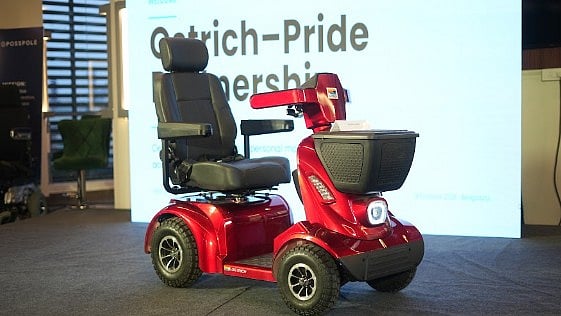
A caregiver-pushed, inflexible body of metal, a thin fabric seat and four wheels — this describes a standard wheelchair used by many differently abled Indians.From government hospitals to airports, Indians very often settle for this basic model of medical aid due to economic restraints.A collaborative event in Bengaluru, on Wednesday, shared a glimpse into a different possibility.Visitors were dazzled to watch switch-operated, cushioned, robust, flexible and seemingly intuitive assistive motor vehicles taking a large share of attention at an event where two manufacturing players, one indigenous and another US-based, joined hands to bring better customization to Indian mobility devices.To tailor specific needs of the differently abled population in India, Ostrich Mobility, an electric wheelchair manufacturer based in Bengaluru (India) collaborated with Pride Mobility Products, a US-based popular designer and manufacturer of personal mobility equipment.“Pride has an established edge in technology. Ostrich has a better understanding of what the Indian market may need. This very much sums up our partnership,” said Venukrishnan Unnikrishnan (Managing director and CEO of Ostrich Mobility Instruments).However, the glamorous showcase of sophisticated medical aids could not erase the disparity between what is needed and what remains affordable in the country for the larger segment of population.Ostrich Mobility representatives (right), chief guest honoring the event and Pride Mobility representatives gather for a commemorative photograph.The ground reality As per official record, roughly 26.8 million Indians live with some form of disability and out of which 6 million may need a wheelchair.Out of these six million, only a fraction (up to 6 per cent) of the differently abled people are able to get their needs fully met, including transport ease and sometimes even getting a comfortable wheelchair, Down To Earth has reported.While government schemes like the Assistance to Disabled Persons for Purchase/Fitting of Aids/Appliances (ADIP) operational under the Department of Empowerment of Persons with Disabilities (DEPwD) does offer cover up to rupees 50,000 or more for more specialized motor wheelchairs, the distribution can have some limitations like a strict or more structural beneficiary criterion. The severity of disability also affects the distribution process. People having 80 per cent or more disability caused by conditions like cerebral palsy, muscular dystrophy, neurodegenerative injuries and others get slightly preferred over others.All these formalities can make the process exhaustive and time consuming.Moreover, the differently abled cannot choose the wheelchair of their own choice and get reimbursed by the government.As per reports, regular servicing of these assistive devices remains challenging in the country with many of its parts not readily available in the market.While the government’s flagship Ayushman Bharat scheme covers secondary and tertiary hospitalization and diagnostic expenditure, wheelchairs do not fall into this category.Even the percentage of insurance policies covering medical aids like a wheelchair are also largely narrow.Collectively, these factors make distribution of assistive technology uneven and more complex than it seems on the surface.When Deccan Herald (DH) asked if this high-end innovation could bring any difference to the existing needs of the country, the healthcare representatives present during the event said: “Should we completely stop celebrating innovation because we cannot afford it or must we strive harder to make it more accessible to at least some if not many?”This opened up a larger question — should countries silence innovation in medicine to make peace with an existing gap in affordability or use it as an incentive to bridge the disparity?Disability rights live in court orders, still absent from government filesLuxury or basic need?In March 2026, the Supreme Court of India directed the cab drivers to be more inclusive of differently abled people after hearing a petition demanding better connectivity for them.“The challenging part of the standard wheelchairs in India is they struggle to navigate the rough terrain of streets. The wheels are not flexible enough to turn their way around uneven ground or steps. Very often, on certain topographies, all four or some of the wheels may lose alignment, one could be placed on land and the other could get suspended in the air,” said an Ostrich representative at a tea table conversation.For Dr Sai Kaustuv Dasgupta, popularly known as the ‘Wheelchair Warrior of India’ and a prominent advocate of disability rights in the country, a comfortable and self-driven wheelchair is not a luxury but a need to lead a dignified life.While sitting on a power-driven wheelchair at the event, Dr Sai said: “After six years of remaining confined to a hospital room due to countless fractures, this chair made me feel alive again. Asking for a chair that can make us live like others or move freely is not a luxury or desire, it is a fundamental need. We spend hours on this chair. It should heal us, not make us more miserable. Differently abled people should not be limited to a corner of the room.”Dr Sai Kaustuv Dasgupta alongside collaborating company representatives gather for a commemorative photograph.Smartphones are luxury, not wheelchairsDefying the showcased high end mobility devices as luxury, Sebastien Lacoste (Director of International Sales at Pride Mobility Products Corporation) and Adner Antonio Pereira, Product Specialist at Pride Mobility said: “You add a few buttons on it to make it move at different angles or a power move that can make it move on its own without needing anyone to do that for one, does it sound like luxury? You know what sounds like luxury, a fairly good segment of the Indian population having an iPhone in their pockets.”As per reports, Apple holds nearly 9 percent of smartphone market share in the country.When DH asked wheelchair manufacturers if their vision supports a smart yet affordable mobility product in India , both Ostrich and Pride representatives said: “Resources and intelligence put in these designs would need a reasonable return. It’s an innovation and we need to first see how it plays out in India. Sometimes, we don’t realize we need something unless it’s right there in front of us. Insurance can play a pivotal role in shrinking consumer gap.”Why do we need customized wheelchairs?When DH asked manufacturing experts as to why differently abled persons need a customizable wheelchair, Sreejith N S, CMO at Ostrich Mobility said: “Differently abled people living with conditions like Cerebral Palsy or Muscular Dystrophy or let’s say a person becoming paralyzed after a stroke event spend about 16 to 17 hours on these chairs. Some may even sleep on it. They do it for all 365 days.”“If these wheelchairs are not aligned with their bodily parameters, the chair can exert unhealthy pressure on different parts of their body. This is why many people develop bed sores. These things can erode the quality of their life,” he added.What does this collaboration mean for India?As per reports, a larger bulk of wheelchairs and other assistive devices in India are imported from other countries China, Thailand, the United Kingdom and the United States.Reportedly, the government exercises a concessional GST rate of 5 per cent for imports.Also, imported wheelchairs are entirely exempt from the Basic Customs Duty (BCD) in India.When DH asked Ostrich the cost range of their basic mobility products, Sreejith N S answered: “It starts from somewhere rupees 39,000 and can go up to rupees 3.5 lakhs.”Sharing the benefits of this collaboration, he added: “Even if a customer in India is able to fetch a smart mobility device through a government scheme or an international market, there is usually no one to help them out when the product malfunctions or needs a service. Either service personnel are not available or product parts are not there in the market. With this collaboration, this problem ends here.”He further clarified that while Pride will drive the design for sometime, the product parts will be assembled in Indian markets.‘Need of the hour’Attending the event as a chief Guest, Dr BS Ajaykumar (Founder and chairperson of HCG) shared his son’s battle against muscular dystrophy and how seeing his son use a smart mobility device changed his perspective on smart mobility devices.“I remember him driving a scooter without any of us worrying about him. This feeling is very precious for a caregiver,” he said.Talking about Indian roads and accessibility for the differently abled, he said: “Indian roads are not at all friendly for people with disabilities. Uneven roads, pot holes, vendors all over the street. Differently abled people here have no freedom, neither in theatres nor in cabs or other public transport. Every step outside their house is a challenge for them.”“India needs to go big on the disability sector. It is highly neglected. There are things we need to learn from other countries, like Barcelona which is one of the most accessible places in the world. Sometimes vehicles become the pivotal point of change,” he added.Insurance coverage as the way aheadMany countries like France, Germany and to some extent the United States are already providing complete or partial coverage for smart, technology-powered medical aids under their government-run insurance policies. While innovation knocks at the door, the provision of insurance coverage and stronger enforcement of existing government policies can ensure better quality of life for India’s differently abled population.
Source: Deccan Herald
🔑 Key Takeaways
- Wire dispatch directly ingested from deccanherald.
- Published at Thu, 15 Oct 2026 14:47.
- Source URL: https://www.deccanherald.com/health/smart-wheelchairs-debut-in-india-but-lack-of-insurance-coverage-may-lock-out-ride-of-freedom-4184110