
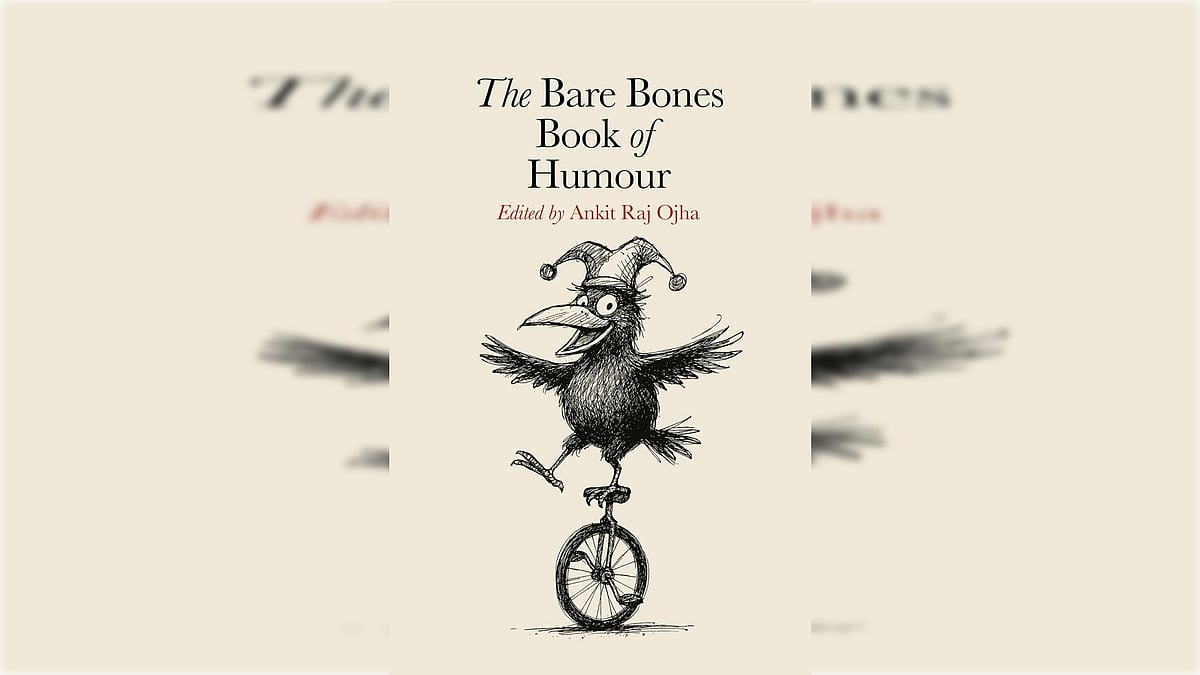
A comic lens to perceive the world
As Ankit Raj Ojha notes in his introduction, humour has long remained the neglected cousin of literary fiction, often dismissed as lightweight or commercially driven, while tragedy continues to command critical prestige. The Bare Bones Book of Humour, which he has edited, quietly overturns this hierarchy.Bringing together 24 writers from eight countries, the anthology demonstrates that humour is not literature’s lighter counterpart but one of its sharpest ways of examining vanity, desire, power, failure, and the countless absurdities of ordinary life. The finest stories in the collection understand that laughter is rarely an escape from reality. There is no singular formula here; the anthology moves effortlessly between satire, irony, absurdism, dark comedy, and quiet wit, suggesting that humour is less a genre than a way of seeing the world. Rather than offering an escape from reality, it refracts reality through a comic lens, rendering its contradictions, pretensions, and absurdities impossible to ignore. Far from asking readers merely to laugh, these stories invite them to recognise themselves.Read of the Week: In the realm of the last manYet what ultimately binds these diverse stories together is not simply their ability to provoke laughter but their acute attention to the textures of ordinary life. Their characters are rarely heroes or villains; they are boastful, insecure, lonely, pretentious, awkward, desirous, and often spectacularly mistaken about themselves. Whether navigating family tensions, bureaucratic absurdities, fragile egos, or the weight of social expectations, the humour arises not from elaborate punchlines but from the silent recognition that everyday life is inherently ridiculous.No identity ever fully secureIn this anthology, comedy becomes a language through which human frailty is rendered with remarkable tenderness. Beneath the laughter lies a recurring fascination with the collapse of certainty. Across these stories, dignity is repeatedly unsettled by the body, by desire, by misunderstanding, by chance, or by the sheer unpredictability of other people. Humour, in this sense, is not simply entertainment; it is literature’s reminder that no identity, however carefully cultivated, is ever entirely secure.Some of the anthology’s most memorable stories demonstrate that humour can illuminate political realities more incisively than solemn realism. In Merlin Flower’s delightfully irreverent Robes and Roles, a woman’s exasperated curse, “F*&* you, God. May you have never-ending periods,” is spectacularly fulfilled when a male god begins menstruating. The outrageous premise quickly evolves into a biting feminist satire on the gendered politics of pain, exposing how casually menstrual suffering is normalised until it is imagined as a male experience. By transforming biological inequality into comic fantasy, Flower lays bare the patriarchal assumptions that quietly structure everyday life.Aparna Kalra’s Protection is equally sharp in its satirical imagination. Set quietly against the backdrop of Uttarakhand’s Uniform Civil Code, which requires live-in couples to register their relationships, the story follows a young man who panics after misplacing the government’s allotted monthly supply of condoms. What follows is a hilariously escalating comedy of bureaucratic absurdity. Yet beneath the farce lies a pointed critique of a state increasingly invested in regulating intimacy, sexuality, and private life. Kalra exposes the absurd consequences of governance that seeks to extend administrative surveillance into the most intimate corners of citizens’ lives, demonstrating how humour can become a remarkably potent language of political dissent.Entertaining and incisiveThe Bare Bones Book of Humour ultimately reminds us that laughter is never as frivolous as it appears. At its best, humour unsettles certainties, punctures pretensions, and renders visible the quiet absurdities that organise everyday life.Whether exposing the invisible burdens of gender, the excesses of bureaucratic power, or the fragile performances through which people sustain dignity and authority, these stories demonstrate that comedy can be as politically incisive as it is emotionally resonant. In bringing together a remarkably diverse range of comic voices, Ankit Raj Ojha has assembled much more than an entertaining collection. He has made a compelling case for humour as one of literature’s most perceptive ways of understanding the human condition. These stories may leave readers laughing, but they remain because they recognise an uncomfortable truth: that the absurd has always been woven into the fabric of ordinary life.
Source: Deccan Herald
🔑 Key Takeaways
- Wire dispatch directly ingested from deccanherald.
- Published at Sat, 12 Sep 2026 23:46.
- Source URL: https://www.deccanherald.com/features/books/the-bare-bones-book-of-humour-a-comic-lens-to-perceive-the-world-4143046