
On November 3, West Bengal Chief Minister Suvendu Adhikari announced Rs 5,000 in assistance for each eligible worker from 21 closed tea gardens in North Bengal. For families whose gardens have shut, the money matters. Bu…
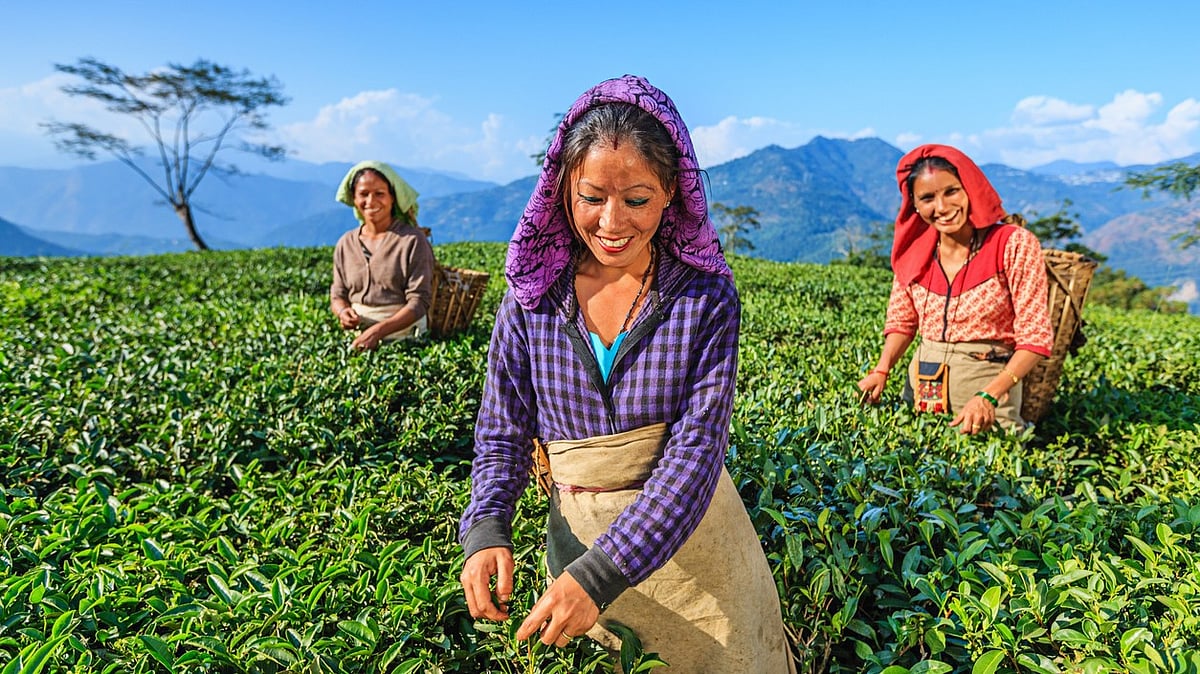
On November 3, West Bengal Chief Minister Suvendu Adhikari announced Rs 5,000 in assistance for each eligible worker from 21 closed tea gardens in North Bengal. For families whose gardens have shut, the money matters. But relief of this kind also raises a deeper question: why is an industry that is celebrated abroad so fragile at home?At Fortnum & Mason in London, 125 grams of Darjeeling first flush sells for £14.95, that’s roughly Rs 1,600. Scaled to a kilogramme, the price exceeds Rs 12,800. Joshila Gurung, a tea leaf plucker at a tea estate in Darjeeling, earns Rs 232 for a full day’s work. Between these two numbers lies an economy that has never been asked to explain itself, and this paradox explains why the future of the world’s most celebrated Darjeeling tea is highly uncertain.Tourists photograph the morning mist over the slopes. What the photographs hide is the structure beneath. Plantations are ‘enclave economies’, closed systems where one employer controls labour, housing and identity. Workers live on rent-free land inside the estates, which they neither own nor can bequeath. The garden employs and contains them, defining the boundary of what they can imagine.Here lies the deepest contradiction. In 2004, Darjeeling tea received India’s first Geographical Indication (GI) tag, a legal instrument intended to ensure a region’s unique qualities benefit its people. Darjeeling to Kalimpong: A Himalayan escape where the journey is the destinationInstead, it has captured the premium that Gurung’s labour creates and delivered it to estates, exporters, and London retailers, while Gurung cannot afford the Rs 400 carpool to the nearest hospital in Siliguri. The brand is protected; the person behind it is not.Tea plucking is classified as unskilled, and the label is not descriptive; it is a mechanism. By treating embodied knowledge, endurance and years of practised precision as unskilled, the industry suppresses wages while the product commands premium prices. Over 50 per cent of tea plantation workers in North Bengal are women, and their legal minimum wage is regularly undercut. That is not merely a welfare question; it is an accounting sleight of hand performed in plain sight.When gardens close, the arithmetic collapses. The Rs 5,000 announced this month equals about 21 days of Gurung’s wages, set against a crisis decades in the making. A nutritional survey conducted after a worker’s death at Garganda Tea Estate found that nearly 38 per cent of the workers surveyed were undernourished, with 24 per cent categorised as severely thin, with a BMI below 17. Between 2000 and 2015, 1,400 people died across 17 closed tea gardens in North Bengal, with severe malnutrition as the primary cause. These are not deaths from drought or disaster; they are deaths from a system in which workers own neither the land nor a real claim to their hard labour.Ecology compounds the problem. Tea is largely a monoculture reliant on fertilisers and pesticides that degrade the soil and strip the biodiversity it depends on, even as climate pressure mounts. For every 1°C rise in temperature, tea yield in Assam falls by 0.087 tonnes per hectare. A 2018 survey found 88 per cent of plantation managers and 97 per cent of smallholders already identified climate as a definite operational threat. When yields fall, wages follow, or gardens close. Workers absorb ecological and market shocks together, with little protection from either. Meanwhile, in 2024, India exported 254 million kg of tea to become the world’s second-largest exporter.Young people are leaving the hills for informal, exhausting, poorly paid work: delivery in Siliguri, construction in Bengaluru, domestic work in Delhi. Most workers now educate their children and send them away and send them away. What is fracturing is the enclave’s core mechanism: its power to make the garden the only imaginable world. The industry has no serious answer because it was never designed to ask the question.Almost three decades ago, Amartya Sen argued that development must be measured in real freedom: the ability to seek medical care without it costing a day’s wage, to keep children in school, to leave without facing destitution. The GI tag was meant to be one such freedom, a mechanism to turn geographical identity into economic dignity. Instead, it has made Darjeeling tea a globally protected luxury brand while leaving Joshila Gurung outside every protection the brand generates.The Rs 5,000 will help, once. The question that remains is why the woman who makes the mist-wrapped gardens beautiful cannot afford to reach a hospital, and why, two decades after India’s first act of geographic justice, we have not thought to ask.Satyajeet Gupta is Senior Advisor, Center of Excellence in Chemical Ecology, UAS-GKVK, Bangalore, and Consultant, Indian Institute for Human Settlements (IIHS), Bengaluru. Shatarupa Sarkar is a doctoral student at the Department of Forest Genetics and Physiology, Czech University of Life Sciences, Prague, Czechia. Priya Karhar is a MA student at the Indian Institute for Human Settlements (IIHS), Bengaluru.(Disclaimer: The views expressed above are the author’s own. They do not necessarily reflect the views of DH.)
Source: Deccan Herald
🔑 Key Takeaways
- Wire dispatch directly ingested from deccanherald.
- Published at Mon, 23 Nov 2026 09:07.
- Source URL: https://www.deccanherald.com/opinion/the-hidden-life-behind-the-beautiful-tea-gardens-of-darjeeling-4228191