
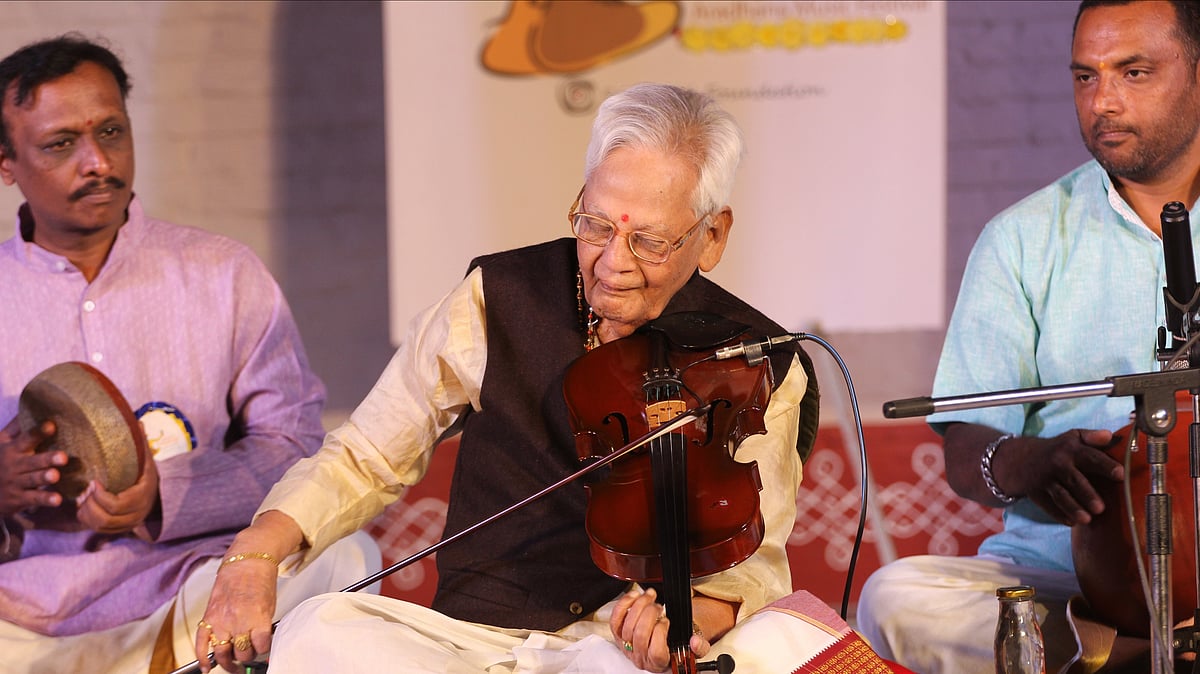
A lifetime of striving and patient ‘sadhana’
As we ring the bell outside the Vijayawada home of violinist Annavarapu Ramaswamy, we hear him asking us to wait. Walking slowly but with ease, he comes to the door, opens it, smiles, ushers us into his drawing room and offers us seats, setting the stage for a friendly conversation.The shelves and showcases around him display more than 100 awards, trophies and citations, including the Padma Shri, testaments to a glorious career spanning eight decades in Karnatik music. Annavarapu garu, as he is widely known, turned 100 in March. Over the decades, he has won the hearts of countless music connoisseurs across generations. He received rigorous training under his guru, the legendary Gayaka Sarvabhouma Parupalli Ramakrishnayya, who is said to be the fourth-generation descendant in the direct lineage of Thyagaraja’s disciples. This makes Annavarapu garu the fifth-generation musician in Thyagaraja’s direct shishya parampara.He has performed as a soloist to acclaim in India and abroad. He has also accompanied and earned the appreciation of stalwarts and icons such as M S Subbulakshmi, Ariyakudi Ramanuja Iyengar, Semmangudi Srinivasa Iyer, who was particularly fond of his music, Flute Mali, M Balamuralikrishna, Voleti Venkateswarulu and Nedunuri Krishnamurthy, among others.‘Abhang’: Bridging the worlds of Indian classical music and devotional poetryBeyond music: Chowdiah Utsava 2026 to begin in Bengaluru from Nov 11As dedicated to teaching as he is to performing, the affable Annavarapu has a legion of disciples, including Top-Grade AIR artistes and Asthana Vidwans of the TTD and Kanchi Kamakoti Peetham. At 100, he continues to teach, making him possibly India’s oldest living violin teacher. He teaches both violin and vocal music, just as his own guru, vocalist Parupalli, who taught the violin as well. Excerpts from an interviewDuring his younger days. How would he describe the difference between being a soloist and an accompanist?I tell my students about the principles that guided my own career as a violinist. When you accompany a main artiste, you have to offer Sahakara Vadyam (supporting or supplementing music), not Ahankara Vadyam (egoistic music). Whether the main artiste is young or old, famous or upcoming, you have to follow his lead.Of course, the accompanying violinist also gets a solo opportunity in a kutcheri. But even here, he has to play the raga that the main artiste initiated. Indeed, a concert featuring Sama Ujjis (equally matched) artistes as the main performer and accompanist, challenging each other musically on stage, can be an aesthetic high and a delight for everyone. However, I advise accompanists against deliberately attempting one-upmanship or trying to overshadow the main artiste. Also, when you are a seasoned violinist accompanying a young, upcoming main artiste, you must gently complement the performer and subtly boost his confidence.What is your advice to aspiring musicians and music students?If you had asked me this question 50 years ago, I would have said, ideally, Gurukulavasam, where a student spends his life surrounded by music. But times have changed. Many students today are also pursuing other academic courses or taking up jobs, and there are countless distractions: television, smartphones, social media and so on. So, here are the timeless essentials: an unquenchable thirst for knowledge, both practical and theoretical; listening, and listening some more, to great vidwans; and gathering an enormous amount of Swaragyanam, which helps in a faster and deeper understanding of lessons, as well as in developing impressive onstage manodharma.Above all, surrender yourself to your art with humility. In Sita Swayamvaram, many approached the Shivadhanush with overconfidence, even arrogance, and failed. Rama, however, emerged victorious because he bowed before it in humility and performed a circumambulation as a mark of respect.Students should never be in a hurry to take the stage. The longer one spends in patient sadhana to perfect one’s art beforehand, the longer one’s career is likely to last. When you are fortunate enough to find a great guru, defer to him completely. When I went to my guru, I already knew 70 kritis and varnams (advanced lessons). In fact, I sang the Darbar-raga varnam when he first asked me to sing.Yet, he began my lessons with geethams (beginner-level compositions)! I complied unquestioningly.How has the music scene changed over the years?There have been so many changes! Changes have occurred in the nature of artistes and audiences, in the way Karnatik music is presented and broadcast, and in how it is consumed and perceived.When I was a teenager, the only way to listen to great performances was to be physically present in the audience. An onstage concert was also the only platform through which an artiste could showcase his vidwat. Besides, those concerts generally lasted several hours.An alapana alone could go on for an hour or more! Then came AIR, a boon for all musicians, followed by television. There were also recording formats such as gramophone records, audio cassettes and CDs, and then those stick-like things (pen drives), which meant that you could listen to artistes from hundreds of miles away, at any time of your convenience. Artistes, too, could showcase their talent to a much wider audience, even without performing on stage.
Source: Deccan Herald
🔑 Key Takeaways
- Wire dispatch directly ingested from deccanherald.
- Published at Sun, 15 Nov 2026 00:15.
- Source URL: https://www.deccanherald.com/features/violin-maestro-at-100-annavarapu-ramaswamys-karnatik-music-journey-4217096