
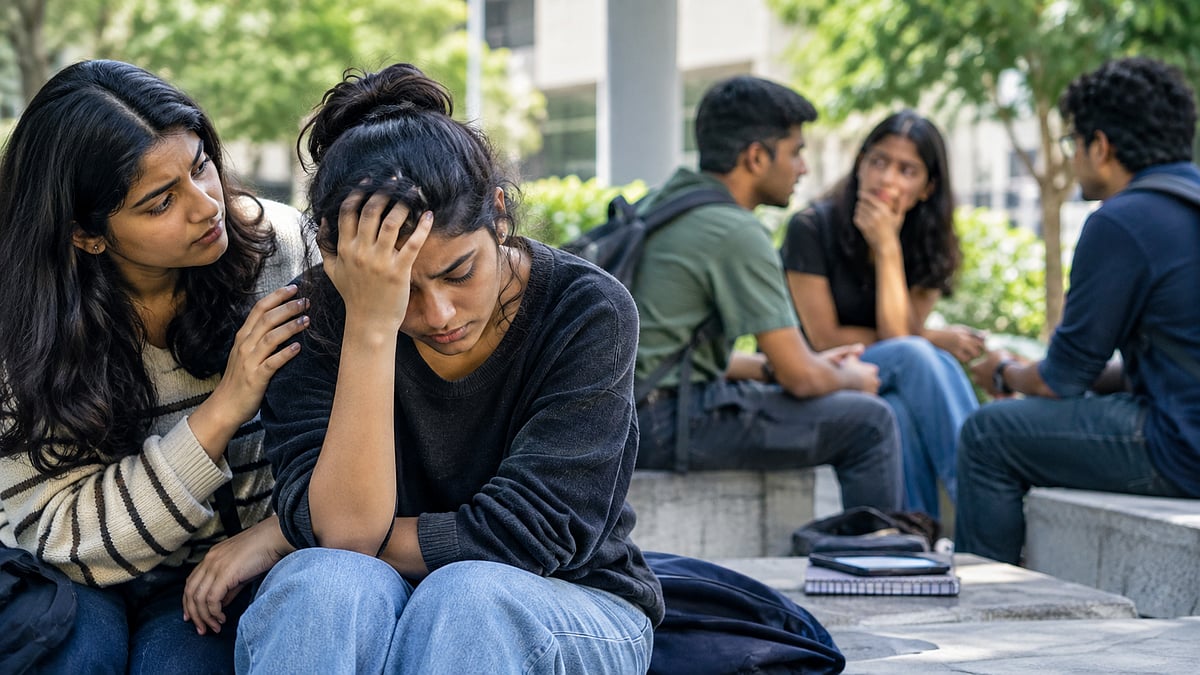
Two weeks ago, India woke to a deeply disturbing news report involving a 19-year-old IIT Bombay student who had died by suicide. The circumstances of every such tragedy are complex, and alleged caste and discrimination-r…
Two weeks ago, India woke to a deeply disturbing news report involving a 19-year-old IIT Bombay student who had died by suicide. The circumstances of every such tragedy are complex, and alleged caste and discrimination-related angles are being widely reported and debated in the media. However, an important aspect not getting sufficient attention in this incident is the mental health of young Indians.Children and young adults are now growing up in an always-on digital ecosystem of smartphones, social media, online gaming, OTT, cyberbullying, relentless comparison and, increasingly, generative AI. Digital technology blurs the boundaries between the classroom, peer group, and private life.The WHO describes digital environments as important determinants of young people’s mental health, carrying both benefits and risks. It has been estimated that globally one in seven adolescents lives with a mental disorder, while suicide is the third leading cause of death among people aged 15 to 29.Precision psychiatry: The latest concept in mental health spaceThe issue is recognised and the Union Ministry of Education has reportedly also been working on a dedicated National Mental Health and Well-Being Policy for Schools. India also has a National Mental Health Policy of 2014, an ongoing National Mental Health Programme, and initiatives such as Tele-MANAS. Therefore, another policy is arguably not the solution.Mental health is one area where the distance between policy and practice becomes especially consequential. A policy can recommend counselling in every school, but who will counsel? It can prescribe early identification, but which teacher has been trained to recognise persistent withdrawal, risk of self-harm, panic attacks, eating disorders or dangerous online behaviour? It can create referral pathways, but referral to whom, where, and within how many hours or days?India has a genuine shortage of psychiatrists, clinical psychologists, psychiatric social workers, and trained counsellors. Simply issuing another set of national or state-level policy directives, therefore, risks producing an impressive document with limited implementation.There is a useful lesson in history of India’s mental health care service delivery. The District Mental Health Programme of India started as a pilot in four districts in 1996 and expanded progressively. That approach recognised a basic public-health principle: when expertise is scarce, start locally, build workable systems, learn from implementation, adapt, and then scale.There is another unlikely but valuable precedent: Heat Action Plans. Ahmedabad did not wait for every Indian city to have an identical national heat protocol. The model was subsequently adapted elsewhere because implementation was locally owned. Mental health now needs a similar shift — from broad aspiration to geographically specific action.Delhi is developing a student-focused mental-health policy, potentially covering counselling, identification of vulnerable students, and institutional mechanisms. The intent is welcome, yet much of what is required already fits comfortably within the 2014 National Mental Health Policy and existing school-health, adolescent-health and mental-health programmes. The need is to develop an action plan and not new policies.Mental health burden doubled since 1990, 1.2 billion people affected globally An action plan is different because it must answer practical questions. Every city should know how many school and college counsellors it actually has; which institutions have none; where the nearest psychologist or psychiatrist is; who responds after a suicide attempt; what a teacher should do when a student expresses hopelessness; how parents are contacted; how confidentiality is protected; and where a young person can seek help without fear of punishment, judgement, or stigma.It must also address today’s rapidly changing realities: cyberbullying, problematic gaming, social-media comparison, sleep disruption, online sexual exploitation, AI-related academic anxiety, and excessive screen use. Schools need protocols for digital crises just as they have fire-safety procedures. Colleges need specific support systems for hostel residents, first-year students, examination periods, and those living away from their families. Coaching hubs require special attention because academic pressure, isolation, and intense competition can converge there.India should begin with city-level mental health action plans in metros, as well as major education hubs such as Kota, Pune, and other coaching- and university-heavy towns. Each plan should be nested within existing government programmes, use available public and private capacity, train teachers in first-line recognition, create referral networks, involve parents and students, and publish measurable indicators of progress.The first measure of success should not be how many counselling rooms are inaugurated. It should be whether a distressed student is recognised earlier, reaches appropriate help faster, and remains connected to care. A policy provides direction. But mental health is ultimately protected in classrooms, hostels, homes, clinics, and neighbourhoods. For Indians between five and 25 years of age, the challenge is local and immediate. Our response must become local too.(Chandrakant Lahariya is a practising physician and author of ‘Pill-Free: You Don’t Need Everything You Have Been Prescribed’.)(Disclaimer: The views expressed above are the author’s own. They do not necessarily reflect the views of DH.)
Source: Deccan Herald
🔑 Key Takeaways
- Wire dispatch directly ingested from deccanherald.
- Published at Wed, 07 Oct 2026 05:59.
- Source URL: https://www.deccanherald.com/opinion/young-india-needs-mental-health-action-plans-not-new-policies-4173302